Supplier price increases now need evidence, not letters
Lindt misjudged demand and Kroger now wants every increase justified. Five checks and four answers for deciding supplier price increases, item by item.
"We overestimated how much we could raise prices without hurting demand." That is Ernst Tanner, chairman of Lindt & Sprüngli, speaking at the weekend, a week after the chocolate maker removed its CEO. Supplier price increases rarely come with a confession attached. This one did, and every retail CEO should read it as a note about their own shelf.
The same week, Kroger told investors that suppliers must justify price increases and earn their place on the shelf. One side of the table admits it pushed too hard. The other side says it will stop accepting the push. Mid-market retailers sit between the two, usually without Kroger's buying power or Lindt's data team. This memo is about what they can do instead.
Two signals in one week
Lindt's numbers explain the confession. Prices rose by an average of 11.8% in the first half of 2026 as the company passed on record cocoa costs. Volumes fell. At the end of September it cut its 2026 organic growth outlook for the second time, from 6-8% to 0-2%, and on 19 October it replaced its CEO (swissinfo.ch). The shares are down more than 25% this year. Tanner said some prices have already been cut to win volume back, and pointed to Germany as the market where it misread demand (ESM Magazine).
Kroger's Investor Day pointed the other way. The grocer set a target of $4 billion in annualized savings. Part of it comes from buying discipline: direct sourcing from under 1% of volume to more than 10%, fewer complex promotions, and the money moved into everyday prices. The line that matters here was short. Suppliers must justify price increases (Supermarket News).
Put the two together and the message is clear. The time when a supplier's letter turned into a shelf price change by default is ending. Not because retailers got tougher. Because the brands themselves found the limit of what shoppers would pay, and found it late.
The supplier's elasticity mistake becomes your shelf problem
When a brand overestimates what shoppers will pay, the brand loses volume. The retailer loses something too. It loses category sales, basket traffic and, on the items shoppers remember, price image. A retailer that passed an 11.8% increase straight through on a premium chocolate range made the same elasticity error as the supplier. It just never got to make the decision.
That is the uncomfortable part. Most retailers treat a supplier increase as a cost event. Finance updates the cost. The margin rule recalculates the price. The shelf tag changes. Nobody asks whether the new price still works for the shopper. The pricing decision is made by a formula that was written for a different cost base.
Lindt had a brand team, years of price history and its own view of the market, and it still misjudged demand. A retailer that applies a flat margin to the new cost has far less information than that. It is betting that the supplier got the elasticity right. This year, that bet lost. We made the same point about blanket increases in our memo on price moves that move nothing: one percentage across items with different sensitivity is an average that is wrong for every item it touches.
Why mid-market retailers pass through too much
When we talk to mid-market retailers, the reasons are almost always operational, not strategic.
- Volume. A buying team with tens of thousands of SKUs can face hundreds of cost changes in a season. There is no time to treat each one as a decision.
- Missing evidence. The team knows the new cost. It rarely has the item's sales response, the competitor shelf price and the item's role in the category on the same screen.
- Margin rules used as defaults. "Hold 35% gross margin" is a sensible guardrail. Used as the only rule, it turns every supplier increase into a retail increase of the same size or larger.
- A weak position at the table. Without data, a buyer cannot push back on a letter. "Our shoppers will not accept this" is an opinion. "This item lost units after the last increase, and two competitors are below our current price" is a negotiation.
A supplier price increase is a retail price optimization decision
The fix is to move the decision out of the cost file and into the pricing workflow. Every cost increase above an agreed threshold gets the same five questions before it touches a shelf price.
- Is the cost real? What input moved, by how much, and does the requested increase match it? Kroger's word, justify, applies here. Ask for the cost build, not a percentage.
- What role does the item play? A key value item that shoppers use to judge your prices behaves differently from a long-tail item nobody compares. The same increase can be harmless on one and damaging on the other.
- How does demand react? Use your own history. How did units move the last time this item, or its category, changed price? If you have no estimate, that is the finding.
- Where is the market? What do the two or three competitors that matter charge today? An increase that moves you from the middle of the market to the top is a different decision from one that keeps you level.
- What is the floor? What margin does this item need to earn its space? Some items can carry less because they bring traffic. Others cannot.
None of this needs a data science team. It needs the cost, the sales history, the competitor price and the rule in one place, and a named person who signs off the answer. That is what retail price optimization software should do at mid-market scale. Not a black box that sets prices on its own, but a workspace where the evidence sits next to the decision.
Four answers, not one
Once the evidence is on the table, a supplier increase has more than one outcome. Most retailers only use the first.
- Pass through. Long-tail items with low price sensitivity and no visible competitor comparison. The cost is real, the shopper is unlikely to notice, and the margin is protected.
- Split. Pass part of the increase now, hold the rest, and review in 8-12 weeks with real sales data. This is the right default when the demand evidence is thin.
- Absorb. Key value items where the price is part of your price image. Absorb, and recover the margin elsewhere in the category on items shoppers do not compare. This only works if the recovery is planned at the same time, not hoped for.
- Push back or replace. When the requested increase is bigger than the cost evidence supports, or your demand data says the new price will not hold. The options are a smaller increase, a private label or second-brand alternative, or less space.
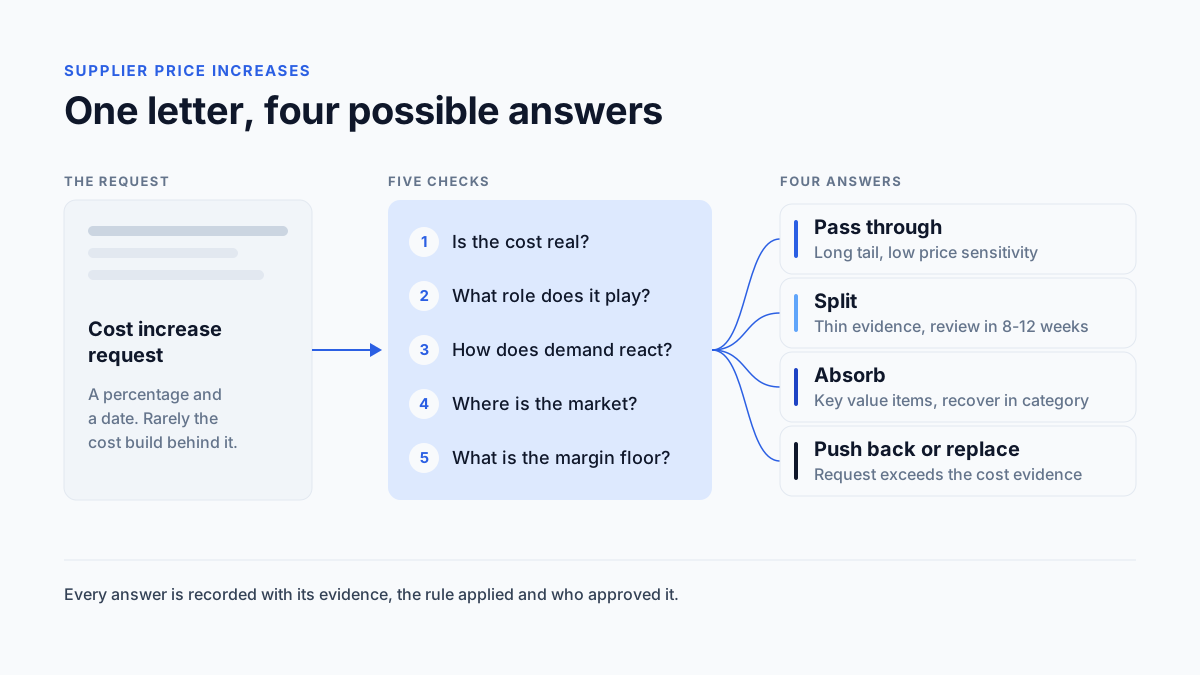
No single answer is right. The answer should differ by item, and the reason should be written down. For cost shocks that hit a whole category at once, our tariff pass-through framework sets out the same choices at portfolio level. For the weekly desk routine that sits underneath them, see our guide to cost-letter triage for category managers.
Costs go down too
Cocoa traded at $5,592 a tonne on 23 October. That is about 57% below its December 2024 record of $12,906, and 11.5% lower than a year ago (Trading Economics). Lindt says further price cuts depend on cocoa returning to more normal levels.
This is the half of the cycle most retailers never manage. Cost increases arrive as letters with deadlines. Cost decreases arrive as silence. If your process only reacts to letters, your shelf prices rise with input costs and stay up when those costs fall. Shoppers notice that gap before your buyers do.
A cost-down review belongs in the same workflow. For every category with a large commodity input, track the input. When it falls a set amount below the level used to justify the last increase, open the conversation. The supplier's own justification becomes your evidence.
Write the reason down
Every pass-through decision is a price change. Every price change is something you may need to explain later: to the supplier in the next negotiation, to a board asking why category margin moved, or to a regulator asking why a price went up. Record the cost evidence, the competitor position, the rule applied and who approved it. Our guide to what a pricing audit trail should log covers the fields.
The record has a second use. Next season, when the same supplier sends a new letter, you can see what happened after the last increase. That is how a retailer builds the demand evidence that would have caught this year's mistake before it reached the shelf.
What this doesn't change
Suppliers are not the villain in this story. Cocoa really did reach record prices. Energy, packaging, labour and freight really did cost more for many of them. A retailer that refuses every increase on principle will lose supply, range and goodwill. A supplier that cannot recover real costs will cut corners somewhere you will not like.
It does not change the range either. Shoppers who come for a brand expect to find it. Delisting is a tool, not a strategy, and the threat only works when the alternative on the shelf is real.
And it does not close the gap in buying power. A mid-market retailer will not get the terms Kroger gets. What it can get is a better conversation. A buyer who arrives with the item's sales response and the market price is harder to dismiss than one who arrives with a margin target. Evidence does not replace scale. It is what you use when you do not have scale.
Five questions for your commercial team this quarter
- How many supplier cost increases did we accept this year, and what share went straight to the shelf?
- For our top 100 items by sales, what happened to units after the last increase?
- Which key value items carry an increase we have not yet checked against competitor prices?
- Which categories have a commodity input that has fallen since we last accepted an increase?
- Where is our pass-through rule written down, and who signs off the exceptions?
If the answers are hard to get, that is the first thing to fix, and it is cheaper to fix before the next round of letters than after it. Our free pricing audit is one way to see where your shelf prices stand against the market today. Or talk to us about running pass-through decisions inside Retailgrid.
Founder and CEO of Retailgrid. 20 years in retail pricing, from Nielsen and IBM DemandTec to founding GoalProfit, a price optimization company he sold in 2023.