Price accuracy is a governance problem, not a store problem
43% of 900+ inspections failed New York's price accuracy bar. A CEO memo on why shelf and register prices drift, and the five controls that stop it.
On 15 October 2026, the New York Attorney General settled with Dollar General over price accuracy. The retailer will donate $1.875 million in food and goods. The numbers behind the settlement matter more than the fine. Of more than 900 state inspection reports, 43% documented price accuracy failures above 2%. Secret shoppers in 11 stores were overcharged on about 14% of the items they bought.
Most executives will file this under store operations. A shelf-tag problem at a discount chain. That reading is comfortable, and it is wrong. Price accuracy is where your pricing process meets the customer. When it fails at scale, the cause usually sits upstream, in how prices are decided, changed and published. That makes it a pricing governance problem, and it belongs on the C-level agenda.
What the regulator actually found
The New York settlement describes a familiar pattern. Prices on shelf tags, print and digital ads, and digital coupons did not match the price at checkout. Receipts were confusing too. Some showed only the full price, some only the net price, some neither.
The bar the stores missed is not exotic. In the US, inspectors follow the NIST examination procedure for price verification. A store passes an inspection at 98% accuracy or better. In a 100-item sample, that means at most two errors. The same procedure flags something subtler. Over a large sample, overcharges should not exceed undercharges. A ratio of two or three overcharges for every undercharge is treated as a possible sign of a systematic pricing problem.
Read the remedies and you see what the regulator thinks went wrong:
- Honor the lowest advertised price whenever shelf, ad and register disagree.
- Independent, unannounced audits of every New York store twice a year.
- District manager audits every six weeks.
- Register prices vetted against the weekly flyer.
- Any discrepancy resolved within 24 hours.
Every one of these is a control on the flow of a price, not on a single tag. And this was not a first warning. Ohio settled with the same retailer for $1 million in 2023, and local inspections kept finding double-digit error rates afterwards. Fixing tags store by store did not fix the system that produced them.
Why price accuracy breaks upstream
A retail price is never one number. It exists in at least four copies:
- The decided price. What the category or pricing team approved, and when it should take effect.
- The system price. What the ERP and POS hold, often after a batch import or a manual edit.
- The shelf price. A paper tag or an electronic label, updated on its own schedule.
- The promoted price. The flyer, the app, the coupon, the website banner.
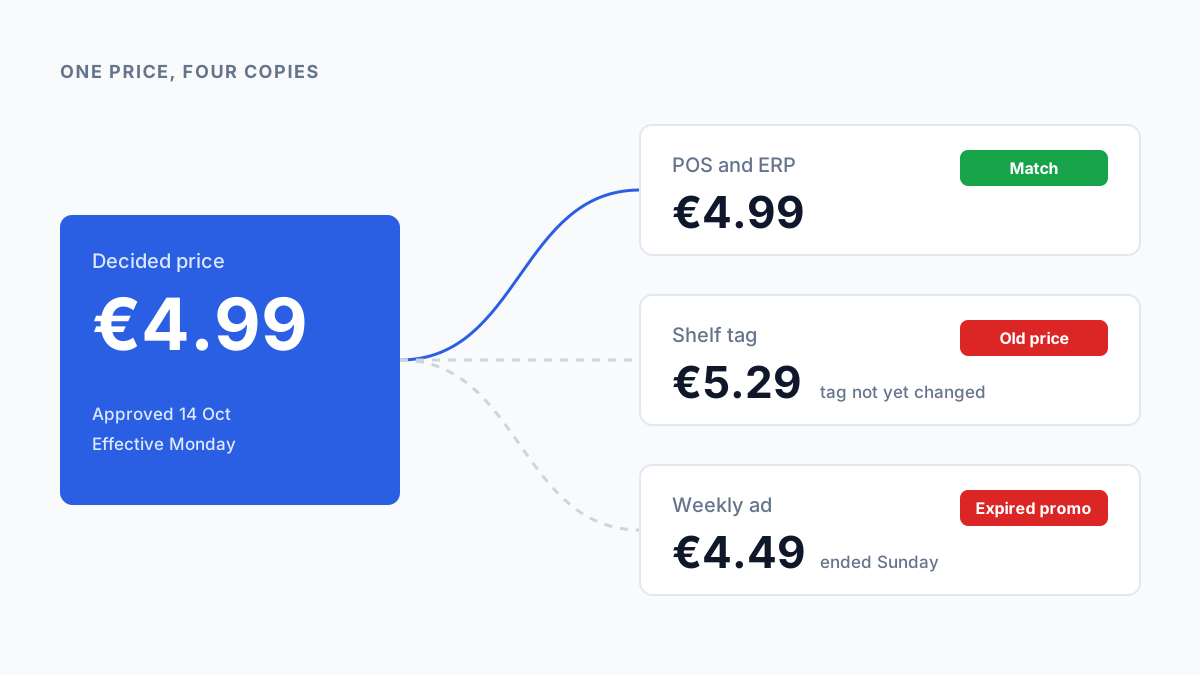
Shelf price accuracy fails when these copies drift apart. Three things drive the drift, and all three are set by the pricing process.
Change volume. Every price change is a chance for an error. A team that moves 3,000 prices a week has more exposure than one that moves 300. Pressure to react faster, to competitors, to costs, to tariffs, raises the count. Few retailers track it as a risk.
Timing. Changes that land after the tag-printing cutoff, or a promotion that ends in the POS on Sunday but stays on the shelf until Wednesday. The decided price was right. The handover was late.
No single record. When prices are decided in spreadsheets, emailed to IT and re-keyed into the POS, nobody can say which copy is the truth. An auditor finds a mismatch. The team cannot prove what the price was meant to be, or since when.
That last point is the governance core. You cannot keep four copies in sync if you cannot name the master.
The fine is the small cost
A settlement is a one-off line in the accounts. Lost trust compounds. A University at Buffalo survey of 2,011 US shoppers found that one in four experiences a checkout overcharge at least monthly. 43% said pricing errors would make them visit a store less often. 26% said they would spend less per trip.
Think about what that means for a mid-market retailer. You spend real margin on price investment in key value items to build a price image. Then a share of shoppers meets a wrong price at the till and walks away with the opposite impression. The price perception you paid for leaks out through execution.
There is also an asymmetry worth naming. Undercharges cost you margin quietly. Overcharges cost you trust loudly, and they are the ones regulators count at the higher enforcement levels. A process that errs both ways is sloppy. A process that errs mostly upward looks, from the outside, like intent.
Pricing governance: the controls a C-level should ask for
Good pricing governance does not mean more approvals. It means every price has an owner, a reason, an effective date and a trail. Five controls cover most of the risk.
1. One approved price record
Every live price should trace back to one approved decision: who approved it, when, why, and from which date. Downstream systems copy from that record, never the other way round. When an inspector or a customer asks what the price should have been, the answer takes seconds. We covered the fields that record needs in the pricing audit trail: what to log for every price change.
2. A change calendar with a hard cutoff
Batch price changes into fixed windows that match how stores update tags and labels. Changes after the cutoff wait for the next window unless someone signs off on an exception. This alone removes much of the timing drift.
3. Promotions with explicit end states
Every promotion needs a start date, an end date and a defined return price. Most shelf-versus-register errors cluster around promotion edges. If the return price is not written down before the promotion starts, someone will guess after it ends.
4. A weekly price accuracy audit
Do not wait for the inspector. Sample prices every week and compare three copies: approved, POS and shelf. Track the result by store and by category. A price accuracy audit run internally is cheaper than one run by a regulator, and it tells you where the process leaks.
5. The overcharge ratio as a board metric
Report two numbers, not one: the accuracy rate and the ratio of overcharges to undercharges. The first tells you how often you are wrong. The second tells you which way, and that is the number a regulator, a journalist or a class-action lawyer will look at first.
Why this is a European question too
It is tempting to read this as a US story about dollar stores and state inspectors. European rules point the same way, and in some markets they go further.
The EU Price Indication Directive already requires the selling price and the unit price to be clear and unambiguous. Since the Omnibus Directive, any announced price reduction must also show the lowest price of the previous 30 days. That changes what "accurate" means. It is no longer enough for today's shelf price to match the till. The price history behind every discount claim has to be right as well. Our Omnibus Directive page covers that rule in detail.
Some CEE markets are pushing further. From 1 October 2026, Croatia requires retailers to show a dated anchor price and publish daily machine-readable price lists, which we covered in anchor prices: when the state publishes your price history. Once the state can read your price file every day, a mismatch between the published list and the shelf stops being a store issue. It becomes a public record.
The direction is clear. Regulators on both sides of the Atlantic are moving from checking a tag to checking the process. The same logic sits behind the debate on dynamic pricing in grocery: the more often prices change, the more the controls around each change matter.
What this doesn't change
Governance upstream does not remove the work in stores. Tags still need to be printed and hung. Staff still need time to do it. A retailer that cuts store hours and then wonders why shelf price accuracy falls has a staffing problem, not a software problem.
Electronic shelf labels help with timing. They shrink the gap between a price change and the shelf. But they display whatever they receive. A wrong decided price, or a promotion with no return price, reaches every shelf faster and more consistently. Automation scales the process you already have, good or bad.
And zero errors is not a realistic target. Dollar General itself has argued in court that a 100% match between shelf and scanned prices is close to impossible. That is fair. The point is not perfection. The point is a known error rate, errors that do not lean towards the customer paying more, and a fix measured in hours, not inspection cycles.
Where Retailgrid fits
Retailgrid sits at the start of the chain: the decided price. Proposed price changes go through an approval step. Every approval records who approved it and when, and each recommendation comes with an explanation of why the price moved. Approved prices are published from one place to the systems downstream. That gives you the single approved record the controls above depend on.
Retailgrid does not print tags or run your POS. It makes the first copy of the price the one you can defend, and it makes the volume and timing of price changes visible, so they can be planned rather than discovered. You can see how that works in the Retailgrid AI workspace.
The question to ask on Monday
Ask your team one thing: if an inspector picked 100 items in our worst store today, what would we score, and how would we know? If the answer is a guess, price accuracy is already a governance problem in your business. It is just not on anyone's dashboard yet.
If you want a second pair of eyes on your price change process, we are happy to walk through it with you.
Founder and CEO of Retailgrid. 20 years in retail pricing, from Nielsen and IBM DemandTec to founding GoalProfit, a price optimization company he sold in 2023.