Retailgrid is now in the Claude Connectors Directory
Our MCP connector grew from 5 read-only tools to 41. Ask Claude why a SKU is priced the way it is, approve proposals and publish prices, with guardrails.
A month ago I wrote that Retailgrid now speaks MCP. Back then it was early access: five read-only tools, a handful of organizations, and a lot of testing with real AI clients. Today it is a different thing. Retailgrid is listed in the Claude Connectors Directory, and the connector can now run a full pricing cycle from a chat window.
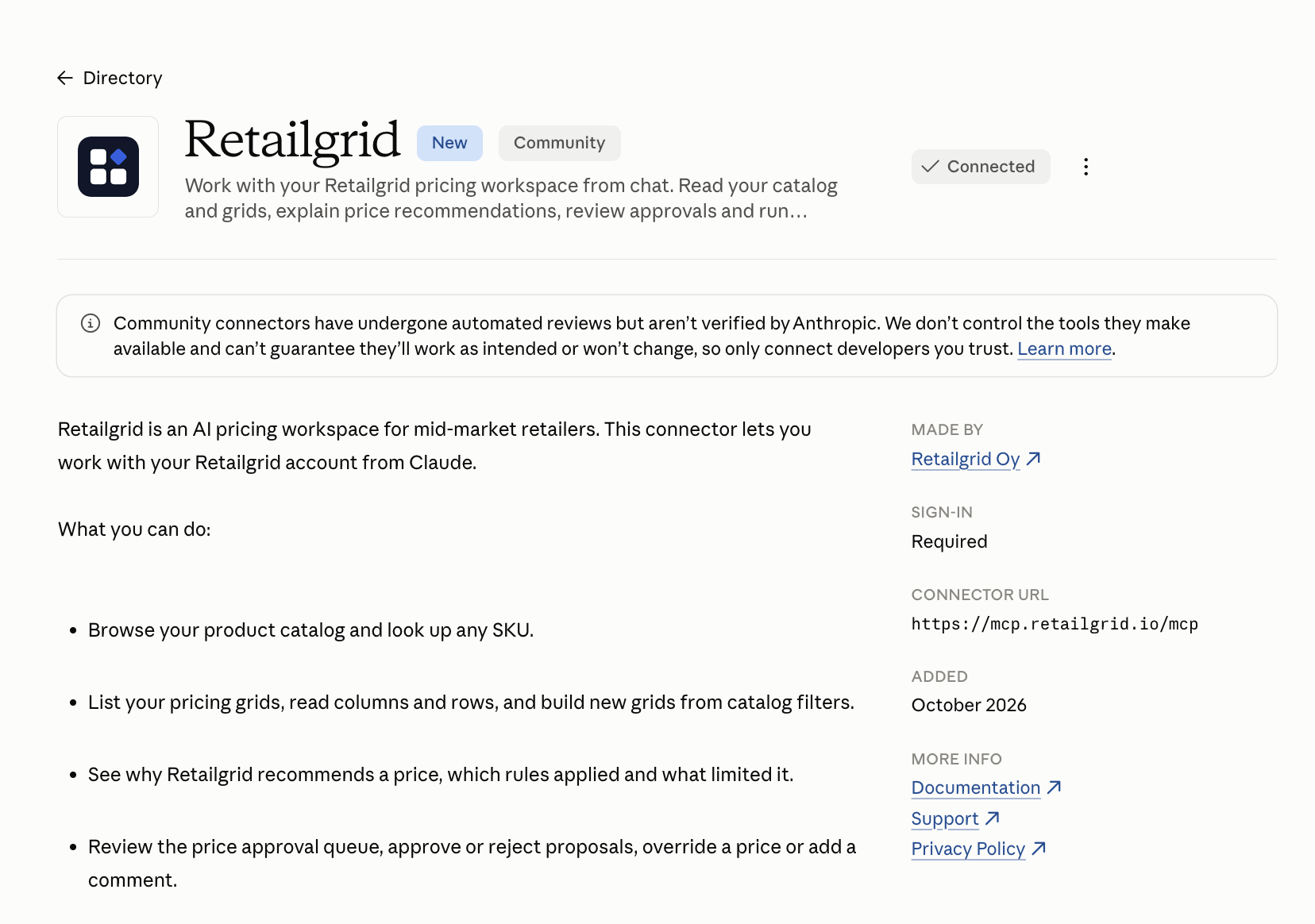
For a pricing team, that changes where the work starts. You no longer have to open the app, find the right Grid and build a filter before you can answer a question. You ask Claude, and Claude asks Retailgrid.
What the Claude connector can do now
The connector has grown from 5 to 41 tools. They cover the same workflow a pricing manager runs in the Retailgrid app:
- Catalog. Browse products and look up any SKU with its price and cost.
- Grids. Create a Grid from catalog filters, preview the scope before you commit, duplicate a tuned Grid, add formula or metric columns and update cells.
- Price optimization. Start an optimization run, follow its progress, and cancel it if the setup was wrong.
- Explainable recommendations. Ask why a SKU got a proposed price. Claude gets the rules that applied, the constraint that limited the price, and a forecast for 7 to 180 days. You can also test a what-if price without saving anything.
- Price approval. Review the queue, approve or reject proposals, override a price, leave a comment, see the forecast impact, and publish approved prices.
- Product roles. Classify the catalog into roles such as KVIs, traffic drivers and profit drivers, and pin a role by hand where you know better.
- Transaction exports. Pull sales history out for your own analysis.
In practice, a session sounds like this:
"Which 20 price changes in my Summer Grid add the most gross profit over 90 days?"
"Why is this SKU priced at 89.99? Show the competitor prices and the rules behind it."
"Approve the proposals with margin above 30% and leave the rest for review."
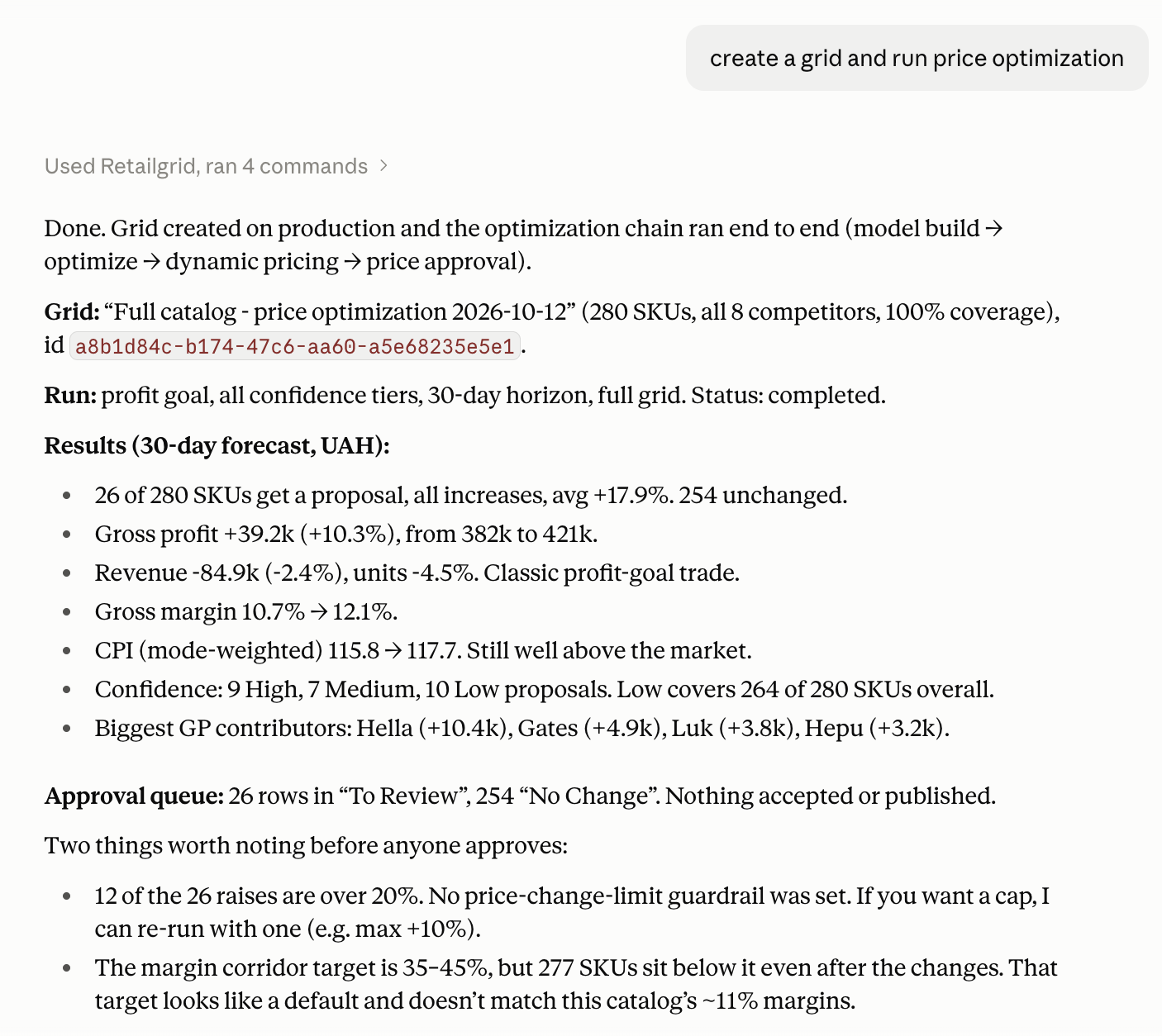
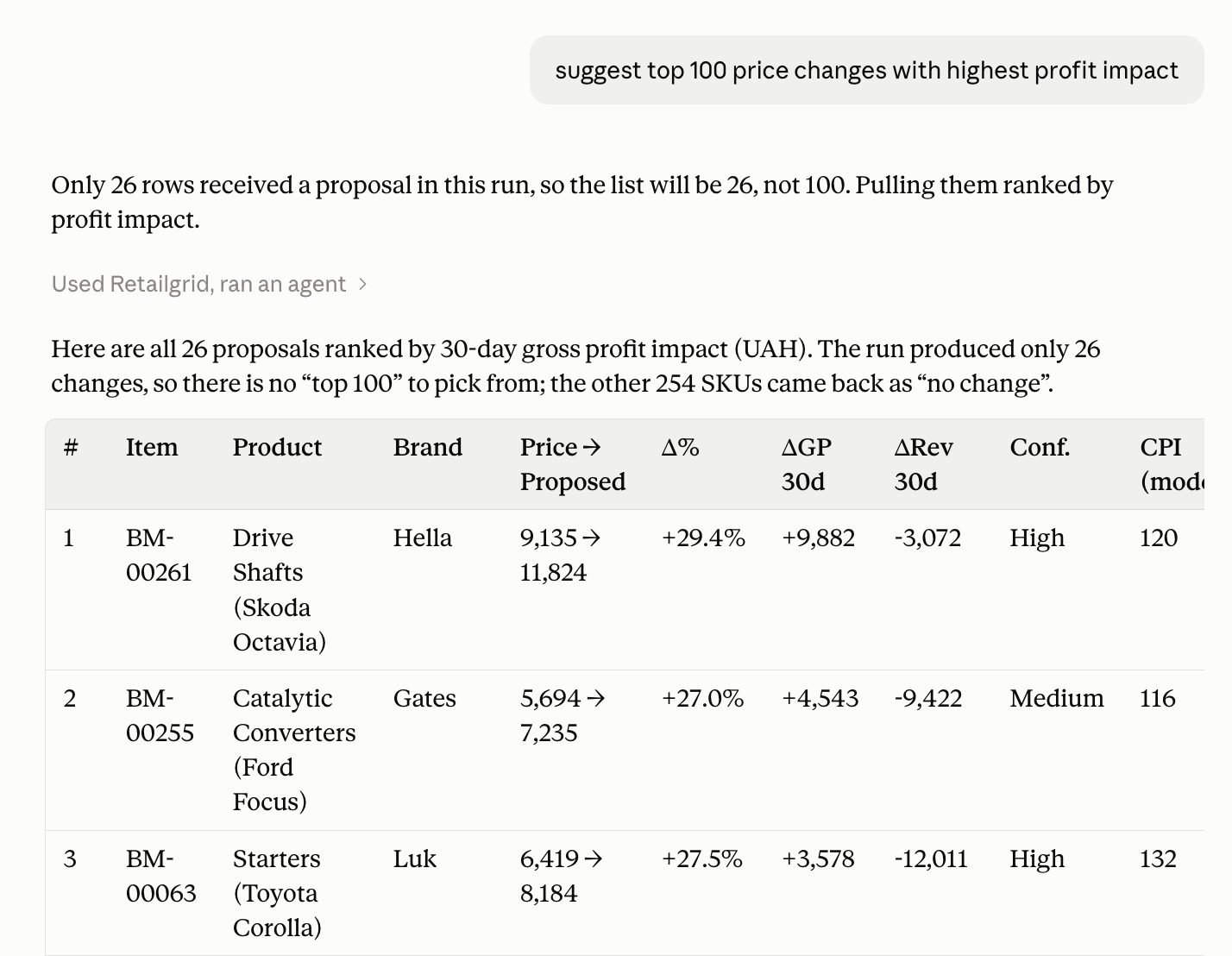
Each of those used to be several screens and filters. Now it is one sentence, and the answer comes back with the reasoning attached.
Why we built pricing into AI assistants
I have spent 20 years in retail pricing. The hard part was rarely the math. It was getting the right number in front of the right person, with enough context that they trusted it and acted on it.
Pricing teams in mid-market retail are small. A category manager might own thousands of SKUs and still answer questions from buyers, store managers and finance all day. Most of those questions are simple to ask and slow to answer: what changed, why, and what happens if we move it.
AI assistants are becoming the place where people ask questions at work. If the pricing system is not reachable from there, the assistant guesses, or someone exports a spreadsheet. Neither is good. We would rather the assistant read the real Grid, show the real rule and leave a trail.
That is also why the connector runs on the Model Context Protocol, the open standard for connecting AI applications to business systems. We build one server, and it works with any client that supports remote MCP.
Write access, with guardrails
A connector that can approve and publish prices needs firm limits. We designed these in from the start:
- Your own sign-in. You connect with your Retailgrid login and approve access in the browser. No API keys to paste.
- Read and write are separate. A connection can be read-only. Changing data needs a separate write permission that you grant explicitly.
- Your permissions, checked every time. Every call is checked against your organization's current access rules. If your role changes, the assistant's access changes with it.
- Private by default. The assistant sees the Grids and jobs you own, not your colleagues' work.
- Nothing goes to the shelf by accident. Approving a price does not publish it. Publishing registers approved prices for delivery to your systems, the same as the Publish button in the app.
- A full audit trail. Decisions, overrides and comments made through the assistant are recorded against the person who made them.
- Revoke any time. Disconnect a client in Settings, and access stops immediately.
Explainable and auditable is how we approach pricing in the app. The connector follows the same rules.
How to connect Retailgrid to Claude
- In Claude, open the connectors directory and search for Retailgrid.
- Click Connect and sign in with your Retailgrid account.
- Review the access request and approve it.
- Ask your first question, for example "List my Grids".
AI connections are enabled per organization. If you are a Retailgrid customer and do not see the option yet, contact us and we will switch it on. The full tool list and setup steps are in the AI connections guide.
What comes next
We are working on the ChatGPT listing next, using the same server. We are also building out the parts of the pricing cycle that still need the app, starting with competitor price monitoring.
If you run pricing for a retailer and want to see what this looks like on your own catalog, book a short walkthrough. Bring a question you could not answer quickly last week. I am curious what it is.
Founder and CEO of Retailgrid. 20 years in retail pricing, from Nielsen and IBM DemandTec to founding GoalProfit, a price optimization company he sold in 2023.