Retail pricing software buyer's guide: features & ROI
A practical buyer's guide to retail pricing software - the features that determine whether a platform delivers ROI, and the questions every mid-market team should ask.
The retail pricing software category is crowded, the marketing language is nearly identical across vendors, and the demos are always cleaner than production. For a mid-market retailer evaluating the category seriously, sorting signal from noise takes a structured approach.
This guide covers the features that actually determine whether a pricing platform delivers ROI - not a feature checklist from a vendor, but a commercial framework from the buyer's perspective. Use it to build a shortlist, structure your demos, and make a decision you can defend to your CFO.
Retailgrid is built for mid-market retailers doing €10M-€500M in revenue. That context shapes the framing throughout.
The four capability layers every serious platform needs
Strip away the marketing language and every retail pricing platform is built from some combination of four layers. Knowing which layers a vendor actually has - versus relabels - is the fastest way to cut through a demo.
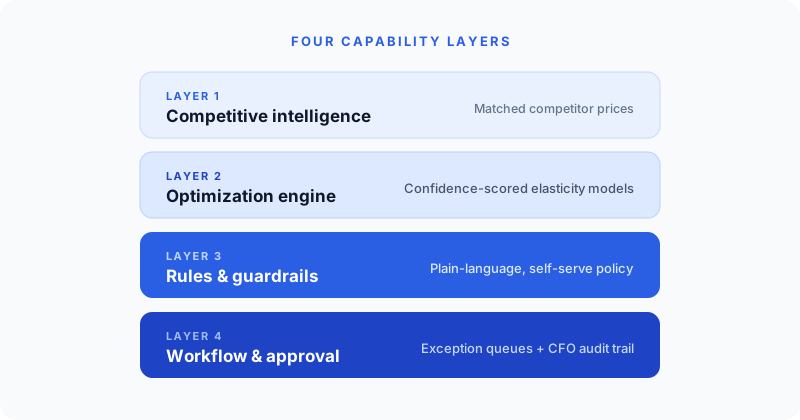
Layer 1: Competitive intelligence. This is the data foundation. Competitor prices, refreshed on a defined cycle, matched to your SKUs, and feeding into pricing decisions automatically. Two questions separate quality data from expensive noise: match accuracy (a confidently wrong match is worse than no data) and refresh frequency on your actual high-velocity SKUs - not the catalog average. The price monitoring standard worth holding vendors to in 2026 is sub-four-hour refresh on KVIs, with match accuracy methodology disclosed and demonstrable on a sample from your own catalog.
Layer 2: Optimization engine. This is where elasticity modeling and margin analysis happen. A genuine optimization engine runs demand models per SKU, scores recommendations by confidence, and applies different levels of conservatism based on data quality. It does not apply the same rule equally to a bestseller with two years of transaction history and a new SKU with three months. Ask any vendor directly: what happens to recommendations on low-confidence SKUs? The answer reveals whether there is a real optimization engine or a rules engine with a more impressive name.
Layer 3: Rules and guardrails. Margin floors, competitor position targets, MAP compliance, daily movement caps, markdown wave triggers - these are the commercial policies your business operates under. A pricing platform should enforce them automatically, consistently, and in a way that is configurable by your category managers without technical support. Rules-based pricing configured in plain language is the operational core of any platform your team will actually use long-term. If rule configuration requires SQL, a developer, or a vendor support ticket, that is not self-service - regardless of how the product page describes it.
Layer 4: Workflow and approval. This is the layer most buyers evaluate last and should evaluate first. A platform that generates a thousand recommendations but has no exception-driven review queue, no bulk approval flow, and no audit trail of who changed what has a functional capacity constraint at the size of your team's manual review bandwidth. Look specifically for: exception queues that surface only the recommendations outside defined parameters, bulk approval on clean low-risk SKUs, and a CFO-readable audit trail on every change - signal, rule, approver, outcome.
The features that separate good from good-enough
Beyond the four layers, these five features determine whether a platform delivers compounding ROI over 12+ months or plateaus at partial adoption after the first quarter.
Explainability by default
Every price recommendation shows the signal, the rule, and the math - not buried in an export, but visible in the workspace next to the recommended price. Less than 1% of traditional pricing tools include human-readable explanations per recommendation. That gap is why most platforms fail at adoption, not at algorithm quality.
Confidence-tiered automation
High-confidence SKUs run on automation within defined guardrails. Low-confidence SKUs route to human review. The tier logic runs automatically - it does not require a data scientist to configure the confidence thresholds per category.
Full catalog coverage
The platforms that generate the highest long-term ROI are the ones that cover the 60-70% of the catalog that manual workflows barely touch. The top 20% of SKUs by revenue are often already well-managed. The margin opportunity is in the long tail - and it only gets captured if the platform covers it consistently from day one.
Deployment in days, not months
Enterprise pricing suites average six to nine months from contract to first live price. For a mid-market retailer, that timeline adds six to nine months of margin leakage to the acquisition cost. The payback window on pricing software is seven to eighteen months from first live price. Every month of deployment delay shifts that window further out.
Self-serve onboarding without IT dependency
Connecting to Shopify or Magento, uploading a catalog CSV, configuring the first pricing rules - all of this should be executable by a commercial team without filing an IT ticket. If the onboarding process requires a developer at any step, evaluate whether that dependency will recur every time the catalog changes or rules need updating.
The ROI framework
Before evaluating any vendor, run this calculation on your own business. It takes 20 minutes and produces the number your CFO will ask for anyway.
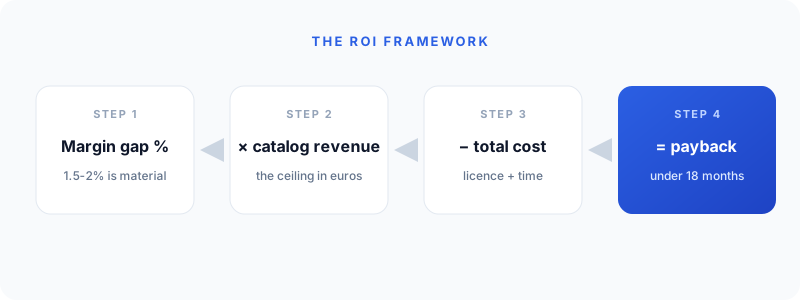
Step 1. Estimate your current margin gap. What percentage of your catalog is priced below your policy-compliant floor, above the competitive midpoint where you have pricing power, or moving toward overstock without a markdown trigger? Even a conservative 1.5-2% margin gap across 60% of catalog revenue is a material number.
Step 2. Multiply by the revenue your catalog generates. A 2% margin recovery on €30M of active catalog revenue is €600K annually. That is the ceiling of the ROI case before the platform costs are subtracted.
Step 3. Subtract total cost of ownership - license, implementation (if any), internal time. A self-serve platform with no implementation partner and a one-week deployment looks very different on this calculation than an enterprise suite with a €50K services engagement and a six-month runway.
Step 4. Divide the net return by the total cost. The payback timeline should land under 18 months for the case to be defensible at board level.
Retailgrid customers have measured an average 2-3 percentage point gross margin improvement within the first six months. The platform deploys from a CSV upload or native Shopify/Magento integration, with most teams reaching their first live price inside a week - no IT project, no implementation partner.
Frequently asked questions
What is the realistic payback window for retail pricing software?
For a well-deployed mid-market platform, payback typically lands at seven to eighteen months from first live price. The two variables that decide it are catalog coverage - how much of your revenue the tool actually touches - and the margin gap between your current prices and your policy-compliant prices. Both are measurable before you buy. Add deployment elapsed time to the calculation: a platform that takes six months to deploy effectively pushes the payback window six months further out.
How should I evaluate vendors in a demo?
Four questions cut through any demo: (1) Show me a price recommendation and explain every element of why it was made. (2) How does the platform handle low-confidence SKUs differently from high-confidence ones? (3) What percentage of your mid-market customers deployed without an implementation partner? (4) Where does the audit trail live and what does it show when a CFO asks why a price moved on a specific date? Vendors who answer all four with specifics are worth taking to a proof of concept. Vendors who pivot or generalize are answering a different question.
Can retail pricing software integrate with our existing ecommerce platform?
Yes - with important differences between vendors. Self-serve platforms like Retailgrid offer native integrations with Shopify and Magento that pull catalog and sales data in and push approved prices out without custom development. Enterprise suites often require custom API connectors that take weeks to configure and need ongoing maintenance when either system updates. Ask specifically whether the integration is native and self-serve, or whether it requires technical resources on your side to implement and maintain.