Is dynamic pricing software right for your retail business?
Dynamic pricing software isn't right for every retailer - but it fits more of them than vendor marketing suggests. An honest framework to decide if it fits yours.
Every pricing software vendor will tell you dynamic pricing is right for your business. That is not useful advice. The honest answer is more nuanced - and more valuable if you are about to spend five figures on a platform.
Dynamic pricing software delivers real, measurable value for a specific kind of retail operation. It underdelivers or adds unnecessary complexity for others. Understanding which side of that line you sit on before you sign anything is worth more than any feature comparison.
This guide is a decision framework, not a sales pitch. Use it to reach a clear yes or no before you book a demo.
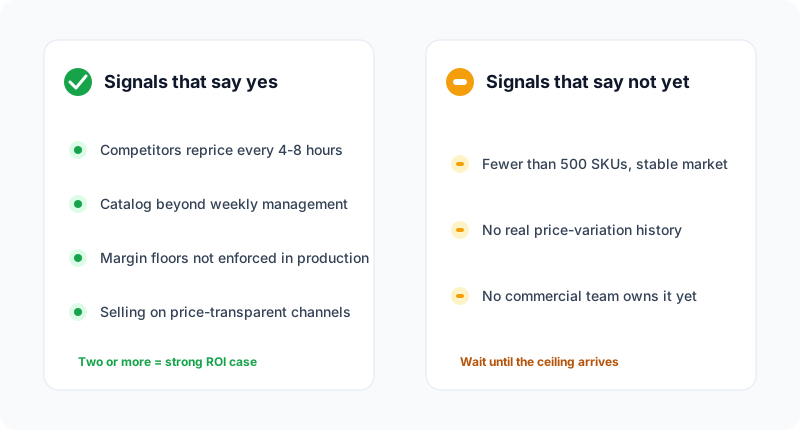
Start with the signals that say yes
Four conditions make dynamic pricing software a clear fit. If two or more apply to your business, the ROI case is strong.
Your competitors reprice faster than your team can track. In electronics, health and beauty, sports equipment, consumer goods, and FMCG, competitor prices shift every four to eight hours on average. A manual repricing cycle that runs weekly - or even daily - means your prices are perpetually behind the market. Every hour of lag on a high-velocity SKU is measurable revenue handed to a faster competitor.
Your catalog has grown beyond active weekly management. Once a catalog passes roughly 1,000 to 2,000 SKUs, a manual workflow covers the top revenue SKUs in detail and prices the rest by inertia. The long tail - often 60-70% of the SKU count - never gets a deliberate pricing review. Dynamic pricing automates the mechanical work across the full catalog, which means underpriced long-tail SKUs get corrected instead of leaking margin quietly for months.
Margin floors are policy on paper but not enforced in production. If your pricing team manually maintains margin floors across a large catalog, the floors are only as reliable as the last person who edited the spreadsheet. Version conflicts, formula errors, and time pressure under promotional deadlines all introduce exceptions that nobody audits. Automated rules-based repricing enforces floors on every price change, without exceptions, at any catalog size.
You are selling on price-transparent channels. Amazon, Google Shopping, and price-comparison sites surface your prices alongside every competitor simultaneously. Customers on these channels make decisions in seconds. A price that is 8% above the market midpoint on a category where switching costs are zero is a direct conversion loss. Dynamic pricing keeps your positioning within defined guardrails on the channels where it matters most.
The signals that say not yet
It is equally worth being direct about when dynamic pricing software is premature.
Fewer than 500 SKUs with a stable competitor landscape. At this scale, a disciplined manual process can cover the catalog with reasonable consistency. The overhead of configuring and managing a dynamic pricing platform may not return faster than the current process improves. The ceiling will arrive eventually - but it has not arrived yet.
No transaction history with real price variation. Dynamic pricing platforms use historical sales data to model price-demand relationships. If your prices barely moved for two years, the model has no signal to learn from. Most platforms handle this gracefully by applying conservative defaults on low-data SKUs - but the optimization ceiling is lower until the data history builds.
No commercial team owns it. Self-serve platforms make dynamic pricing accessible without IT or data science support. But someone on the commercial team still needs to configure rules, review recommendations, and make strategic decisions about which categories automate and which require approval. If that accountability does not exist yet, the platform will underperform regardless of how good the software is.
The questions that decide it
Before booking demos, answer these three questions about your current pricing operation.
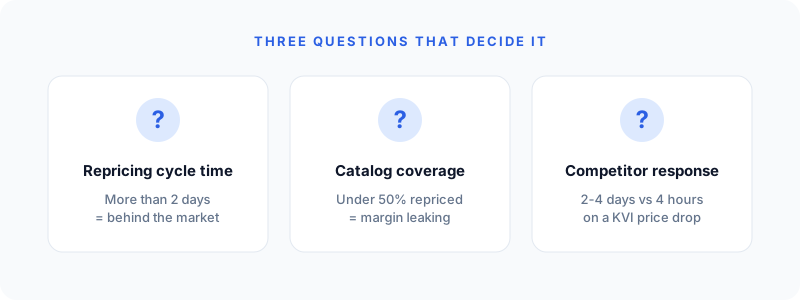
How long does your full repricing cycle take per category?
If the answer is more than two days, you are already behind the market in any category where competitors reprice more frequently. The margin impact of that lag is the floor estimate of what dynamic pricing software returns.
What percentage of your catalog was actively repriced in the last 30 days?
If the answer is under 50%, you are pricing a majority of your catalog by inertia. The margin recovery from covering that gap consistently is the core ROI case for the platform.
What happens when a competitor drops price significantly on a KVI today?
If your team would find out in two to four days, that response lag is a measurable cost. Dynamic pricing software with a four-hour competitor refresh cycle closes it to hours.
If your answers to these three questions add up to a material margin opportunity - and they usually do for retailers above €10M with catalogs over 1,000 SKUs - the business case is real.
What it looks like in practice
Retailgrid is built for mid-market retailers who have answered yes to the framework above and need a platform that deploys in days, not months.
The platform combines live competitor monitoring refreshed every four hours, a rules engine configurable in plain language, and an AI agent that recommends, explains, and applies price changes - all in a single grid that works the way your team already thinks. Autonomy is configurable by category: full automation on low-risk SKUs, human review on strategic lines.
Real outcomes from Retailgrid customers include a 90% reduction in repricing time for Winely (420+ SKUs, online grocery), 5.1% revenue growth for an electronics chain across 8,000 SKUs, and an 18% improvement in markdown efficiency for a multi-brand fashion retailer. Read the full details on the case studies page.
The interactive demo runs on a real retail dataset - no signup, no sales call - and shows the complete day-one workflow your team would run.
Frequently asked questions
Is dynamic pricing software suitable for small retailers?
It depends on the category, not the size. A small retailer in electronics or health and beauty competing on price-comparison sites faces the same repricing speed problem as a large one. The relevant threshold is catalog complexity and competitor repricing frequency - not revenue alone. Retailgrid supports retailers from €10M upward, and most go live on a single category before scaling to the full catalog.
Will dynamic pricing cause customer complaints about fluctuating prices?
Done well, dynamic pricing is largely invisible to customers. KVIs and high-visibility products are typically configured with tight guardrails - small daily movement caps and strict competitor positioning rules - to maintain consistent positioning on the products customers benchmark. The long-tail SKUs that benefit most from optimization are rarely the ones customers price-check across competitors.
How does dynamic pricing handle promotional periods and sales events?
A well-configured dynamic pricing platform supports promotional rules alongside everyday repricing - including blackout windows that freeze prices during a sale event, promotional floor overrides, and time-bounded rules that revert automatically after the promotion ends. These are configurable in the same plain-language rules interface as everyday pricing logic, without requiring a separate promotional pricing tool.