Price monitoring software for ecommerce: a 2026 buyer's guide
A buyer's guide to price monitoring software for ecommerce - what to look for, what separates a useful tool from a costly dashboard, and how it feeds margin.
Price monitoring software sounds simple. Track what competitors charge. Get alerts when they change. React accordingly.
In practice, it is one of the most unevenly executed capabilities in ecommerce pricing - and the gap between a well-configured monitoring setup and a poorly built one shows up directly in margin, not in a dashboard metric nobody looks at. This guide is for ecommerce teams evaluating price monitoring software in 2026 - whether you are running a Shopify store with 2,000 SKUs, an omnichannel retailer with 50,000, or somewhere in between. It covers what to look for, what questions cut through vendor claims, and how to avoid the three mistakes that make monitoring tools expensive without being useful.
Why price monitoring matters more in ecommerce
Ecommerce created a pricing environment with no equivalent in physical retail. A shopper in a store cannot instantly compare your price against five competitors in three seconds. A shopper on Google Shopping can - and does.
The practical consequence is that price gaps which would be invisible in a brick-and-mortar context become conversion-rate variables online. A competitor undercutting your price by 6% on a category where customers comparison-shop does not just cost you margin on that product. It costs you the customer for that session. In a marketplace, it costs you the impression entirely.
The speed of this dynamic is what makes manual monitoring structurally inadequate. Competitors on Amazon and Google Shopping reprice continuously. A monitoring workflow that runs weekly - or even daily - is always responding to yesterday's market.
The three things price monitoring software has to do well
1. Data collection and refresh frequency
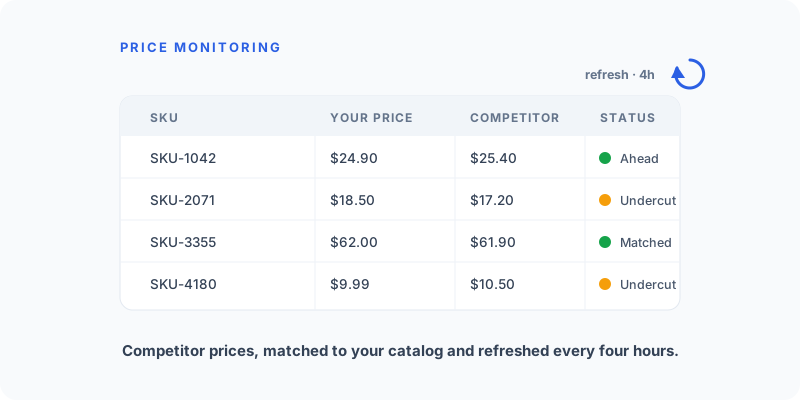
Four hours is the practical minimum for fast-moving categories like electronics, health and beauty, and consumer goods. Less than that and the data is stale before you can act on it.
The less obvious metric is source coverage. A tool that only scrapes competitor websites misses marketplace pricing, price-comparison feeds, and promotional pricing that only appears on specific channels. For ecommerce teams competing with Amazon or Google Shopping, source coverage is often more important than refresh frequency.
2. SKU matching accuracy
This is the feature most buyers evaluate last and should evaluate first. A competitor price is only useful if it is matched to the right product. Wrong matches - your premium version against their entry-level product, a bundle against a single unit - produce numbers that look like data but make your pricing worse.
Ask every monitoring vendor directly: what is your match accuracy methodology? How do you handle product variations, bundle packs, and model updates? A vendor who cannot answer these questions clearly is not one whose data you should trust for pricing decisions.
3. Integration with your pricing workflow
Price monitoring is only valuable if it changes a price. A dashboard of competitor data your category manager exports on Fridays is not monitoring - it is reporting with extra steps. The tool needs to feed directly into repricing rules so a competitor move triggers a response automatically, or surfaces as an actionable alert in the same workspace where prices get set.
What to look for when evaluating platforms
- Four-hour or better refresh on your high-velocity SKUs. Ask for the refresh rate on the specific SKUs that matter to you - not the catalog average, which can be inflated by infrequently-monitored long-tail items.
- Match accuracy verified on your catalog. Request a proof-of-concept match on 100-200 of your own SKUs before signing. Review the matches manually. The error rate you see on that sample is the error rate your pricing decisions will be based on.
- Native integration with your ecommerce platform. Shopify and Magento connections that push competitor data directly into a repricing workflow are worth more than a monitoring tool with an export button. If monitoring and repricing are separate tools with a CSV handoff between them, every hour of delay in that handoff is margin left exposed.
- Alert configuration that drives action. Alerts should be configurable by threshold - not just "competitor changed price" but "competitor undercut my price by more than 5% on a KVI with stock available." Generic alerts create noise. Specific threshold-based alerts create decisions.
- Coverage across channels you actually compete on. For most ecommerce teams in 2026, this means website prices, Amazon, Google Shopping, and at least one or two marketplace feeds relevant to your category.
Where monitoring alone falls short
Price monitoring tells you where you are relative to the market. It does not tell you where you should be.
Knowing that a competitor is 8% below you on a product is useful data. Knowing whether that gap is costing you conversions, whether closing it would recover more margin than it costs, and whether the competitor's position is temporary - that requires demand modeling, price elasticity analysis, and optimization logic that monitoring tools do not provide on their own.
This is why the most effective ecommerce pricing setups in 2026 combine monitoring with optimization in the same workflow. Retailgrid is built on this premise. Competitor prices refresh every four hours and feed directly into an AI optimization engine that recommends price moves, shows the reasoning, and applies them through native Shopify or Magento integration. The monitoring is not a separate contract. It is the data layer the rest of the platform runs on.
The practical difference is in time between signal and action. Monitoring-only workflow: competitor moves, alert fires, manager sees it hours later, updates spreadsheet, imports to storefront. Monitoring-plus-optimization: competitor moves, rule fires, recommendation surfaces, manager approves in bulk, price updates automatically. Same market event. A fraction of the elapsed time.
Ecommerce-specific considerations
- Buy Box dynamics. For teams selling on Amazon, price monitoring needs to account for Buy Box positioning, not just absolute price. A 2% reduction that wins the Buy Box on a high-velocity SKU has a completely different revenue impact than the same reduction on a product already winning it.
- Google Shopping feed consistency. Price inconsistencies between your website and your Shopping feed are one of the fastest ways to lose impressions. Monitoring that surfaces your own cross-channel misalignments is as valuable as tracking competitor prices.
- Speed of price publication. A native Shopify integration that pushes prices instantly differs from a monitor-export-reprice-import cycle that takes two hours. In fast-moving categories, two hours of exposure is real money.
Frequently asked questions
How often should ecommerce teams monitor competitor prices?
In fast-moving categories - electronics, health and beauty, sports equipment, consumer goods - four hours is the minimum refresh rate that keeps data actionable. In slower categories with weekly or less frequent competitor changes, daily monitoring is sufficient. The practical question is: how fast do competitors move in your category, and how fast can you actually respond? If your response time is 48 hours regardless, increasing monitoring frequency provides diminishing returns until you fix the response workflow first.
What is the biggest mistake ecommerce teams make with price monitoring tools?
Buying monitoring as a standalone tool without a plan for how data feeds into pricing decisions. A dashboard showing competitor prices is only valuable if someone acts on it - and in a catalog of 10,000+ SKUs, that cannot mean a manager manually reviewing every alert. The ROI of monitoring is in the price changes it triggers, not the data it collects. Evaluate monitoring tools based on how quickly and automatically they close the loop between signal and price change.
Does price monitoring software work for teams selling across multiple channels?
Yes - but coverage quality varies significantly between platforms. Multi-channel teams need monitoring that covers their website, marketplaces, and the price-comparison sites their customers use. They also need tools that surface internal inconsistencies - their own prices misaligned across channels - not just competitor positions. Look for platforms that offer channel-specific match accuracy and cross-channel price consistency alerts.
Want to see live competitor prices matched to your own catalog - refreshed every four hours and wired straight into your repricing rules? Get in touch and we'll set it up on your data.