Automated repricing vs dynamic pricing: what's the difference?
Automated repricing and dynamic pricing get used interchangeably - but they aren't the same. What each does, where one ends and the other begins.
If you have spent any time evaluating pricing software, you have run into both terms - often in the same sentence. Vendors use "automated repricing" and "dynamic pricing" interchangeably, which makes it genuinely difficult to understand what you are actually buying.
They are not the same thing. They overlap, but the distinction matters practically - for the features you need, the platform you choose, and what you should realistically expect from each. This guide draws the line clearly between the two, explains where they work best independently, and covers why the most effective retail pricing setups in 2026 use both together.
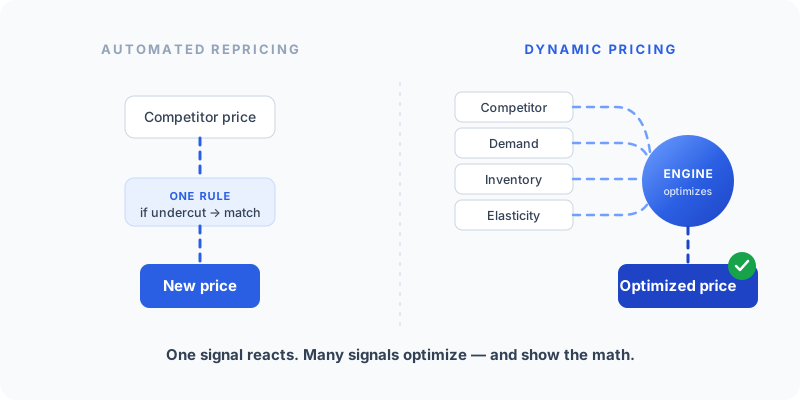
The short version
Automated repricing is reactive. It responds to a specific external signal - usually a competitor price change - according to a rule you set. The rule is binary: if condition A is met, do action B.
Dynamic pricing is broader. It responds to multiple signals simultaneously - competitor moves, demand shifts, inventory levels, time-of-day patterns, stock thresholds - and determines the optimal price given all of those inputs, your rules, and your business objectives. It incorporates demand modeling. Automated repricing does not.
Every dynamic pricing system includes automated repricing as a subset. Not every automated repricing tool is dynamic pricing.
What automated repricing does
Automated repricing tools watch competitor prices and apply rules when conditions are met. The logic is typically structured as: "If competitor X is priced below my price by more than Y%, set my price to competitor X's price minus Z%."
That is it. The rule fires. The price changes. No demand analysis. No margin optimization. No inventory consideration. No signal beyond the competitor price.
For marketplace sellers - particularly those optimizing for Amazon Buy Box velocity - automated repricing is exactly the right tool. The objective is simple: win the Buy Box by being the lowest eligible seller. The logic is simple. The execution needs to be fast. Automated repricing does that job well.
For omnichannel retailers with category management complexity, margin floors that need consistent enforcement, and SKUs with varying price sensitivity, automated repricing alone is a partial solution. It responds to one signal (competitor price) and ignores everything else. A rule that says "always match the lowest competitor" enforced on every SKU - regardless of elasticity, margin, or inventory position - will erode margin systematically on products where you could have held a premium.
What dynamic pricing does
Dynamic pricing software incorporates multiple signals simultaneously and uses optimization logic to find the price that best serves your defined objective - whether that is maximizing gross margin, protecting revenue, or accelerating sell-through on overstock.
The signals a dynamic pricing system typically responds to include competitor prices, your own demand signals and sales velocity, inventory levels and days-of-stock, time-of-day or day-of-week demand patterns, seasonal sell-through targets, and promotional calendar context.
The optimization logic applies elasticity modeling per SKU - estimating how demand responds to price movement - and recommends the price that hits your business objective given the current state of all those signals. The recommendation is scored by confidence: high-confidence SKUs with strong data history get more aggressive moves; low-confidence SKUs get conservative adjustments or a flag for human review.
This is what distinguishes dynamic pricing from automated repricing in practice. A dynamic pricing recommendation for a high-velocity electronics SKU might say: "We recommend $219.99 - competitor A is at $224.99, demand velocity is above seasonal average, stock position is healthy, and elasticity modeling suggests a $5 increase costs less than 2% in volume while recovering 1.4pp margin." An automated repricing rule would say: "Match competitor A: $224.99." Two completely different outputs from the same competitor price signal.
Where each one fits
Understanding the right tool for the right job clarifies the decision significantly.
Automated repricing is the right choice when:
- Your objective is simple and singular - win the Buy Box, match the market, undercut by a fixed percentage
- You are selling primarily on marketplace channels where price is the dominant conversion variable
- Your catalog is homogeneous - similar products, similar margins, similar competitive dynamics across SKUs
- Speed of execution is the primary requirement and the rule logic is stable
Dynamic pricing is the right choice when:
- You manage multiple categories with different price sensitivity and different margin requirements
- You need the same platform to handle KVI pricing, long-tail pricing, clearance, and promotions with different logic for each
- Your CFO needs to understand why a price moved - not just that a rule fired
- You want margin optimization, not just competitive parity
- You are managing inventory signals alongside price signals
For most omnichannel mid-market retailers, the answer is dynamic pricing - with automated repricing as the execution layer underneath it, applying rules that the optimization engine set.
The explainability difference
This is worth calling out separately because it determines whether a pricing tool is trusted or ignored after the first 90 days.
Automated repricing tools show you what happened: "Price changed from $49.99 to $47.99 because Competitor A moved to $47.49." That is useful for auditing. It does not help your category manager explain to a buyer why the product is at $47.99, or help your CFO understand why margin in that category moved 80 basis points.
Dynamic pricing platforms - the good ones - show you why the recommendation was made: the signal, the rule, the elasticity estimate, the margin delta, the alternatives that were considered. That explainability is not a reporting feature. It is what determines whether your team trusts and acts on the recommendations, or reverts to the spreadsheet after the first unexplained price drop.
Retailgrid's agentic pricing approach is built around this distinction. Every recommendation shows its math before any price moves. Category managers approve with confidence because they can see exactly what drove the output. Finance teams can audit any price at any point in time. The tool gets used consistently - which is the only way it delivers sustained margin improvement.
Can you use both?
Yes - and the best setups do. The practical architecture looks like this:
Dynamic pricing sets the strategy: elasticity-informed base prices, margin floors by category, competitive positioning targets by SKU role (KVI, long-tail, exclusive). Automated repricing executes the reactive layer: when a competitor moves on a monitored SKU, the repricing rule fires within the guardrails the optimization engine set.
The dynamic pricing layer answers "what should this price be, strategically?" The automated repricing layer answers "a competitor just moved - should my price change right now, and by how much?"
Run together in the same platform, they close the loop from strategy to execution without a manual step in between. That is exactly what Retailgrid is built to deliver - optimization and rules-based automation in a single workspace, with every price change traceable from the signal that triggered it to the rule that governed it to the approval that authorized it.
Frequently asked questions
Is automated pricing the same as dynamic pricing?
No. Automated repricing responds to a single signal - typically a competitor price change - according to a fixed rule. Dynamic pricing incorporates multiple signals simultaneously, applies demand modeling and elasticity analysis, and recommends the price that optimizes a defined business objective. Automated repricing is a subset of what dynamic pricing systems do. A dynamic pricing platform includes repricing automation as part of its execution layer; a repricing tool does not include optimization.
Which is better for an ecommerce retailer on Amazon?
For pure Amazon marketplace selling focused on Buy Box optimization, automated repricing is often sufficient - the objective is singular and the logic is simple. For an ecommerce retailer who also runs a DTC website, sells on Google Shopping, and manages margin and inventory targets alongside marketplace velocity, dynamic pricing is the appropriate tool. The two objectives - marketplace velocity and margin optimization - require different logic applied to the same catalog.
How do I know if my current tool is automated repricing or dynamic pricing?
Ask one question: does the platform model how demand responds to price changes per SKU, and does that modeling affect what price it recommends? If yes - it has a dynamic pricing component. If the platform only responds to competitor prices according to a rule, without demand modeling, inventory awareness, or margin optimization - it is an automated repricing tool, regardless of what it is called on the product page.
Not sure which layer your catalog actually needs? Get in touch and we'll walk through it on your categories - no black box, every recommendation showing its reasoning.