Price optimization software: from chaos to margin in days
Spreadsheet pricing chaos costs mid-market retailers real margin every week. How price optimization software fixes it - and why the switch takes days, not months.
Twenty spreadsheet files. No version control. A repricing cycle that takes four days per category. A CFO asking why gross margin slipped 80 basis points - and the only answer available is a shrug.
This is not a failure of talent or effort. It is what happens when a pricing operation built for a 500-SKU catalog is asked to handle 20,000. The spreadsheet was never the problem. Scale was.
Price optimization software exists to close exactly this gap - not by replacing your team's judgment, but by giving them the infrastructure to exercise it at a speed and scale that manual workflows physically cannot reach. And in 2026, the right platform does it in days, not the six-month implementation projects that made the category feel inaccessible for years.
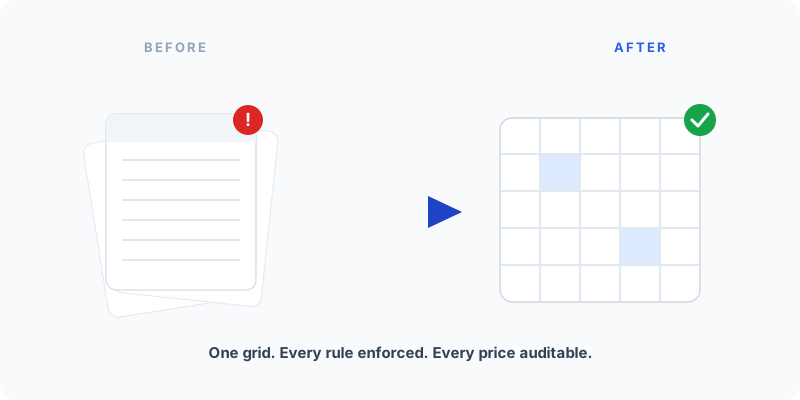
What "chaos" actually looks like
The chaos in a spreadsheet-driven pricing operation is rarely dramatic. It is quiet and cumulative - which is precisely what makes it expensive.
Category teams run 20 or more untracked pricing files with no shared source of truth. Fewer than 5% of SKUs get reviewed weekly; the rest are priced by inertia. A margin floor that exists in policy is not enforced on every SKU because nobody audits every cell of every file after every edit. Competitor data lives in a separate export that gets reconciled manually - sometimes - before the weekly repricing cycle.
The result is a pricing operation that is always reactive, never strategic, and completely invisible to anyone who needs to explain a margin outcome after the fact. Not because the team lacks capability. Because the tool has hit its ceiling.
How price optimization software fixes it - layer by layer
The fix is not one thing. It is three connected layers that work together in a single workspace.
A grid that works like a spreadsheet - but doesn't break. Retailgrid's AI Workspace is designed to feel like Excel - filter, pivot, formula - wired to live competitor prices, sales data, and inventory levels. Category managers work in an environment they already understand. The brittleness of Excel at scale disappears. The familiarity does not.
Rules that enforce themselves. Every pricing constraint - margin floors, competitor position targets, MAP guardrails, markdown wave triggers - is written once in plain language and applied consistently across the full catalog on every price change, automatically. No copy-paste errors. No version conflicts. No margin floor that exists on paper but not in production.
AI recommendations with the math shown. The agentic pricing engine runs six elasticity tiers per SKU, scores each recommendation by confidence, and surfaces the signal, the rule, and the margin delta before anything goes live. Category managers approve in bulk on low-risk SKUs and review exceptions on strategic categories. Every change is logged. Every decision is auditable. The CFO question now has a one-click answer.
From first upload to first live price: the actual timeline
The six-month implementation timeline that made enterprise pricing software unattractive to mid-market retailers is a product of how those platforms were designed - not a technical requirement of the category.
Here is what the transition looks like with a self-serve platform:
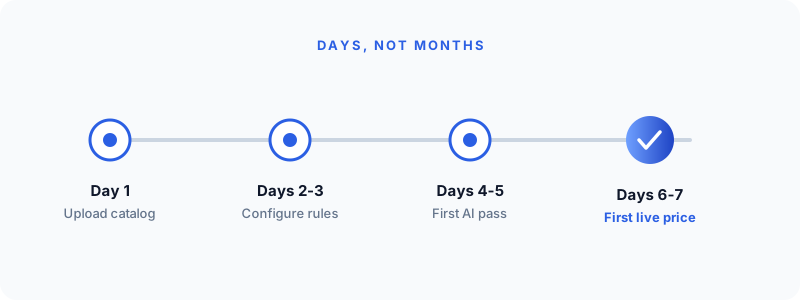
Day 1. Upload your product catalog CSV or connect via the native Shopify/Magento integration. The platform maps products, competitors, and costs into the grid. Gaps and opportunities surface immediately - underpriced SKUs, margin floor violations, categories with no competitive benchmark.
Days 2-3. Configure pricing rules in plain language. Margin floors by category, competitor position targets on KVIs, MAP guardrails on key brands. The platform converts them into version-controlled, auditable logic.
Days 4-5. The AI agent runs its first recommendation pass. Every recommendation shows the signal, the rule, and the expected margin impact. Approve in bulk on low-risk categories, review exceptions on strategic SKUs.
Days 6-7. Approved prices push to the storefront automatically. First live price achieved. No IT ticket submitted at any step.
Winely, an online wine retailer in Germany, followed this path across 420+ SKUs and measured a 90% reduction in repricing time with a 2.3% gross margin uplift - without increasing team headcount. The electronics chain they compare against? 8,000 SKUs, 95% competitor coverage, 5.1% revenue growth, sub-four-hour response time to competitor moves.
These are not projections. They are what pricing teams measured after moving from spreadsheet chaos to structured retail pricing software.
The ROI calculation that actually matters
The payback window on well-deployed price optimization software lands at seven to eighteen months from first live price - if execution is clean and the platform covers enough of the catalog to matter.
The two numbers that decide it: the share of catalog revenue the tool actually touches, and the margin gap between your current prices and your policy-compliant prices. Both are measurable before you buy. If your current repricing cycle leaves 2% gross margin unrecovered on 60% of your catalog, the math is straightforward - and favorable.
The number that kills the ROI case is deployment elapsed time. A platform that takes six months to deploy adds six months of continued leakage to the cost. That is why deployment speed is a financial variable, not just an operational preference.
Frequently asked questions
How quickly can price optimization software go live on a real retail catalog?
With a self-serve platform like Retailgrid, most mid-market teams reach their first live price within a week of starting. Onboarding begins with a CSV upload or a native Shopify/Magento connection - no IT project, no implementation partner, no staging environment. The first AI-generated recommendations appear the same day data is uploaded.
Does price optimization software replace my category managers?
No. The best platforms are designed to work alongside category managers, not replace them. The software handles the mechanical work - monitoring, rule enforcement, recommendation generation - and returns that time to the decisions that require genuine judgment: strategic SKU positioning, channel conflict management, promotional planning. Every recommendation requires review and approval before prices move.
What margin improvement can a mid-market retailer realistically expect?
Retailgrid customers have measured an average of 2-3 percentage points gross margin improvement within the first three to six months of deployment. The improvement varies by catalog, category, and how large the gap was between actual prices and policy-compliant prices before deployment. The most reliable predictor is how many SKUs in your catalog are currently priced by inertia rather than active review.