Dynamic pricing software for electronics retailers
Electronics is the most price-competitive US retail category. What dynamic pricing software needs on speed, coverage, and MAP - and what to ask.
If you sell consumer electronics in the US, you already know the problem.
A typical electronics buyer compares prices across five or more retailers before checkout. Hero SKUs in competitive categories change price three to eight times a day. And a single competitor repricing 8,000 SKUs overnight - which happens - can shift the competitive landscape on your entire catalog before your team arrives on Monday morning.
Manual pricing workflows were not built for this environment. A four-day repricing cycle means your prices spend most of their life responding to market conditions that no longer exist. Every hour your prices are out of step with the market on a high-velocity SKU is a conversion loss you can measure but rarely see attributed in weekly reporting.
Dynamic pricing software for electronics is not optional infrastructure in 2026. It is how the teams that win on margin in this category operate. Here is what it needs to do - and what to look for before you commit.
Speed: the non-negotiable starting point
In electronics, the relevant metric for competitor data is not whether it refreshes daily. It is whether it refreshes fast enough to be actionable before the market moves again.
Four hours is the practical minimum for hero SKU categories. Some platforms advertise this number. The question worth asking is whether they deliver it on your specific high-velocity SKUs or on a catalog average that is inflated by infrequent monitoring of long-tail items.
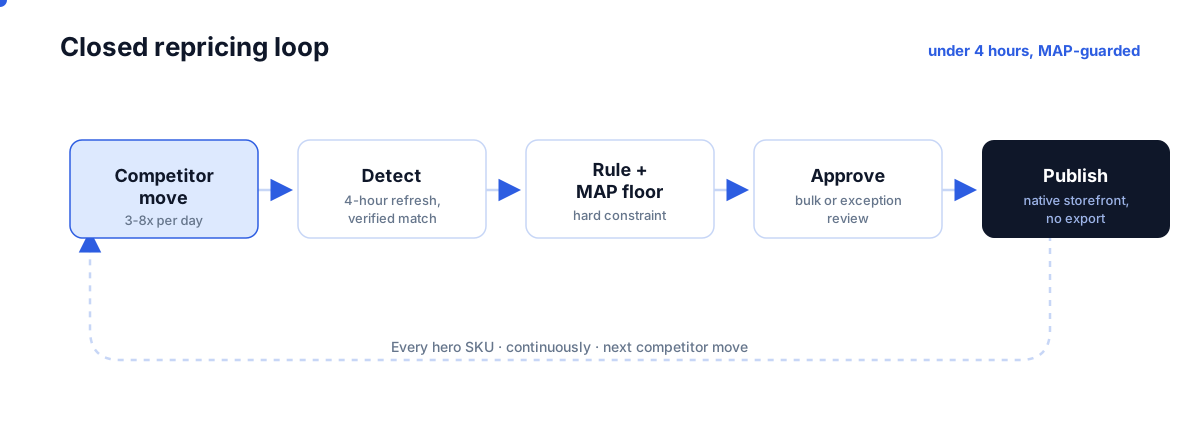
The competitive repricing loop in electronics works like this: a competitor moves on a hero product, the monitoring layer detects it within the refresh cycle, a rule evaluates the new competitive position, a recommendation surfaces, the category manager approves, the price pushes to the storefront. Every step in that chain adds elapsed time. The platforms that deliver genuine sub-four-hour responses do so because monitoring, rule evaluation, approval, and publication are all in the same workflow - not connected by CSV exports and scheduled syncs between separate tools.
A Central European electronics chain running 8,000 SKUs on Retailgrid achieved under four hours average response time to competitor price moves, 95% competitor coverage across the full catalog, and 5.1% revenue growth. That outcome came from closing the loop between monitoring and repricing - not from a better algorithm. The price monitoring layer refreshes every four hours and feeds directly into repricing rules without a manual step in between.
Coverage: hero SKUs and the long tail
Most electronics retailers manage their hero SKUs carefully. The top 20% of SKUs by revenue get weekly or more frequent attention from the pricing team. Competitor positions are monitored. Rules are current. Margin floors are enforced.
The other 80% of the catalog - the accessories, the components, the mid-tier products, the older model variants - gets priced by inertia. Whatever the price was last time someone looked, it probably still is. In a catalog of 8,000 SKUs, that means 6,400 products sitting at prices that reflect a competitive landscape from weeks or months ago.
This is where electronics pricing software earns its value beyond the hero SKU layer. Agentic AI that can surface margin opportunities across the long tail - underpriced SKUs where you have pricing power, overpriced items where stock is moving slowly, products where a competitor has exited and your price anchor is no longer relevant - generates compounding margin recovery that manual teams never get to.
The key distinction is between platforms that apply uniform rules across the full catalog and platforms that differentiate by SKU role. Hero products and KVIs need tight competitor response thresholds and sub-four-hour monitoring. Long-tail items need different logic - conservative moves, confidence-governed recommendations, and human review routing for anything unusual. A platform that treats all 8,000 SKUs identically is not covering the catalog. It is applying the wrong tool to most of it.
MAP compliance: the electronics-specific risk
MAP - Minimum Advertised Price - is more consequential in electronics than in almost any other retail vertical. Electronics manufacturers enforce MAP aggressively. Violations generate chargebacks, channel conflicts, and in serious cases, termination of distribution agreements.
The dynamic pricing software you run needs to enforce MAP guardrails on every automated price move without exception. Not as a periodic audit. As a hard constraint on every repricing rule, every agentic recommendation, and every bulk approval - before anything reaches the storefront.
This is also where match accuracy in monitoring becomes a compliance issue, not just a data quality issue. A platform that monitors competitor MAP compliance but matches the wrong product to your SKU produces false confidence about your competitive position. If your platform is telling you a competitor is above MAP but the match is actually to a different model, you are making pricing decisions on bad data.
The electronics platform evaluation should include a direct demonstration of MAP guardrail enforcement: show me a scenario where a repricing rule would move a price below MAP, and show me exactly how the platform blocks it and routes it for review.
What the right platform looks like in practice
For US electronics retailers evaluating dynamic pricing software in 2026, the shortlist criteria are specific.
Sub-four-hour competitor refresh on hero SKUs, with verified match accuracy - not catalog-average refresh on unverified matches. Rules configurable in plain language by your category managers, with MAP floors enforced as hard constraints. Separate rule logic for hero SKUs versus long-tail - not one rule set applied uniformly. Recommendations that show their math - the competitor signal, the rule, the margin delta - before any price moves. And a native Shopify or Magento integration (or direct marketplace connector) that closes the loop from approval to live price without a manual export.
Retailgrid is built around these requirements for mid-market electronics retailers - self-serve from a catalog upload, live on first hero category within a week, audit trail on every price change, no IT project required.
Book a 20-minute demo to run it against your own electronics catalog, or explore the electronics pricing workflow in detail before committing.
Frequently asked questions
How does dynamic pricing software handle electronics products with frequent model updates?
Product lifecycle management is one of the trickier aspects of electronics pricing automation. When a new model launches, the pricing context for the previous model changes immediately - both in terms of competitive position and in terms of demand trajectory. Good platforms handle model transitions by flagging SKUs where the competitive match has changed, adjusting elasticity assumptions for lifecycle stage, and surfacing the old-model clearance opportunity as a separate workflow from the new-model launch pricing.
What is the right autonomy level for electronics hero SKUs?
For hero SKUs - the products that drive 60%+ of category volume - most electronics teams configure tight guardrails rather than full automation. The standard setup is: automated monitoring and alert generation, automated rule evaluation, but human approval required before prices move on hero products. Full automation runs on the long tail within defined margin floors and movement caps. This gives the speed benefits of automation on the majority of the catalog while maintaining human control on the SKUs where a wrong price move has the highest business impact.
How do you handle competitor prices that appear to be below MAP?
Competitor MAP violations should surface as alerts in your monitoring workflow - not trigger automatic price matching. Matching a competitor price that is itself in violation of MAP puts you in violation too. The right response is to flag the violation for your brand relationship or purchasing contact, not to reprice to the violation level. Most serious pricing platforms support this workflow with a MAP violation alert routing separate from the standard repricing queue.