Price monitoring that feeds directly into repricing
Monitoring and repricing sit in two separate tools in most retail stacks - and the gap costs margin daily. What true integration looks like.
Most US retailers running competitive pricing have two tools where they need one workflow.
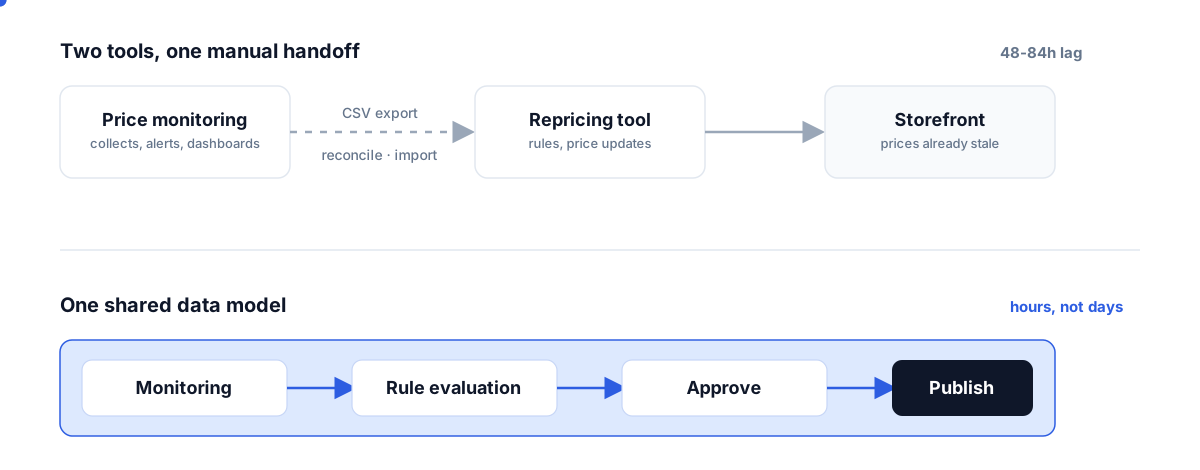
On one side, a price monitoring platform - it collects competitor prices, sends alerts, builds dashboards. On the other side, a repricing tool or a spreadsheet - it holds pricing rules and updates prices. In between sits a manual handoff: export the monitoring data, reconcile it against the catalog, import it into the repricing workflow, initiate the update cycle.
That handoff is where margin disappears.
Not dramatically. Not all at once. But consistently, every week, on every SKU where a competitor moved and your price did not respond fast enough because the data had to travel through three manual steps before reaching the rule that was waiting to act on it.
This post is about what changes when that handoff is removed - when price monitoring and repricing rules share the same data model and the same workspace, so that a competitor price change triggers a rule evaluation automatically, without a human touching the data in between.
Why the two-tool stack exists - and what it actually costs
The separation between monitoring and repricing is historical, not technical. Monitoring tools came first - scraping competitor websites, building dashboards, sending alerts. Repricing tools followed, initially for marketplace sellers optimizing Amazon Buy Box velocity, then broadening into retail more generally. By the time integrated platforms emerged, most retailers had already invested in both.
The integration between them became a scheduled export - typically a CSV that someone runs twice a week, sometimes daily if the team is disciplined.
In categories where competitors reprice every four hours, a twice-weekly monitoring-to-repricing export means your prices are responding to data that is between 48 and 84 hours old by the time they affect your storefront.
Put a number on that. A competitor who drops price on a hero SKU Wednesday afternoon appears in your Friday export. Your repricing workflow processes it Monday morning. You have been out of position for three and a half days on a high-velocity product in a category where customers compare prices across multiple sites before buying.
In electronics, health and beauty, and grocery - categories where price drives 30% or more of purchase decisions - that exposure compounds across every SKU where competitors are actively managing prices. The margin your monitoring tool detected but did not act on quickly enough is real recoverable revenue sitting on the table every week.
What "feeds directly into repricing" actually means
The phrase gets used loosely by vendors. An export button with a scheduled sync is not direct integration. It is a slightly automated handoff - and it still leaves most of the lag in place.
Genuine direct integration requires four things working together.
A shared data model. Competitor prices, your SKU catalog, your cost data, and your pricing rules all exist in the same database. When monitoring data and pricing logic share a data model, rule evaluation fires on live data the moment a competitor price changes - not on a snapshot from the last sync cycle.
Immediate rule evaluation. When a competitor price changes, the system checks it against your rules instantly - not on the next scheduled batch. A rule that evaluates on a twelve-hour sync is responding to a twelve-hour-old snapshot of the market. That is not competitive pricing. That is competitive reporting.
Recommendations in the same workspace as monitoring. If your category manager checks competitor positions in a monitoring dashboard and then opens a separate tool to update prices, they are operating a two-tool stack regardless of what the technical integration looks like underneath. The recommendation - with the competitor signal, the rule that fired, and the margin delta - should appear in the same interface where the monitoring data is visible.
Native storefront publication. The loop closes when approved prices push automatically to your ecommerce platform without a manual export. A monitoring-and-repricing workflow that still requires a price export at the final step has an open loop at the point that matters most.
What the closed loop looks like in practice
When all four elements are in place, the workflow looks like this.
A competitor drops price on a product you both carry. The price monitoring layer detects the change within its refresh cycle - four hours or less. The system immediately evaluates the new competitor price against your configured rules: is this competitor in the tracked set for this SKU? Does the new price cross a threshold that triggers a rule? What is the current margin position relative to the new competitive situation?
If a rule applies, a recommendation surfaces immediately in the pricing workspace - with the competitor signal, the rule that fired, and the margin impact shown before any price changes. Low-risk SKUs get bulk-approved in seconds. Strategic categories route to exception review. Approved prices push to Shopify or Magento through a native integration. No export. No import. No reconciliation.
From competitor price change to your storefront update: hours, not days.
This is exactly how Retailgrid is architected. Price monitoring is not a separate product bolted onto the repricing tool. It is the data layer that the rest of the platform runs on. Competitor prices refresh every four hours from web crawlers, marketplace integrations, and market data providers - mapped to your SKUs automatically, feeding repricing rules in real time, with recommendations surfacing in the same AI Workspace where category managers configure rules and approve price changes.
The practical result for a US electronics team: imagine running 8,000 SKUs with 15 competitors and achieving consistent sub-four-hour response time to price moves - without a manual step in the middle of the loop.
The evaluation checklist for US retailers
Before signing any price monitoring contract, run through these questions.
Is the monitoring data and the repricing logic in the same database? Ask specifically - not "do they integrate" but "do they share a data model." The answer tells you whether rule evaluation fires on live data or on a sync snapshot.
What is the actual lag between a competitor price change and a repricing recommendation surfacing in your workspace? Ask for a real demonstration, not a theoretical refresh cycle. Watch the vendor trigger a competitor price change and time how long it takes to appear as a recommendation in the workspace.
Does rule evaluation fire in real time or on a scheduled batch? If the answer is a scheduled batch - even a frequent one - there is lag built into the architecture that no process improvement will eliminate.
Is the final publication step automatic or manual? A native Shopify, Magento, or marketplace integration that pushes prices without an export is the baseline. An export step at the end means the loop is still open at the point that matters most.
Book a 20-minute walkthrough to see the full monitoring-to-repricing loop running on a real catalog. The competitive pricing workflow page covers the specifics of how Retailgrid handles each of these requirements.
Frequently asked questions
Can I keep my existing monitoring tool and just feed it into a repricing platform?
You can - but the integration will still create a handoff, and that handoff will still add lag. The refresh cycle of your monitoring tool, plus the sync frequency between tools, plus the time to evaluate and approve a recommendation, sets a floor on your response time that a connector cannot eliminate. The only way to genuinely close the loop is to have monitoring and repricing share a data model. Teams that switch to an integrated platform like Retailgrid typically retire their separate monitoring contract as part of the consolidation, since the built-in monitoring covers the same function at the same or better refresh frequency without the integration overhead.
How important is SKU match accuracy compared to refresh frequency?
Match accuracy is more important. A monitoring tool that refreshes every two hours but matches your premium product to a competitor's entry-level variant is generating confident wrong data - and a repricing rule that fires on that data is making your competitive position worse, not better. When evaluating monitoring platforms, always request a verified match accuracy demonstration on a sample from your own catalog before committing. The error rate you see on that sample is the error rate your pricing decisions will be built on.
What is the ROI of closing the monitoring-to-repricing gap?
The ROI depends on how many SKUs in your catalog have active competitor pricing and how long your current response lag is. A practical way to estimate it: identify the percentage of your catalog where a competitor is actively pricing below you on any given week. Multiply by the number of days that exposure persists before your current workflow responds. That exposure window, multiplied by the conversion impact of a price gap in your category - a function of your category's price elasticity - is the recoverable revenue sitting in the gap. Most US mid-market retailers find the number is larger than they expected when they run it on real catalog data.