Member pricing is a price cut: model it like one
Loyalty points and member prices are a second price on every SKU. A four-step workflow to model member pricing by product role and set guardrails.
Petco reported its second quarter this week. Comparable sales were up 0.6%. Net sales were flat. The gap between the two was the new loyalty programme: point redemptions, in the CEO's words, "far exceeded our initial projections", and the CFO put the cost at "mid-single-digit millions" in a quarter where sales had been tracking above guidance before launch. Nobody at Petco decided to cut prices. But member pricing is a price cut, and it behaved like one.
This is not a Petco problem. It is a category management problem, and it is about to get more common. Kaufland in Czechia just multiplied the points on its loyalty card by ten. JD Sports says personalised offers are a "multi-million-pound" opportunity. Every retailer we talk to has a member price, a points scheme, or a personalised coupon engine either live or in a roadmap. Most of them price those mechanics in a different meeting, on a different spreadsheet, from the one where shelf prices get set.
This article is the workflow to close that gap, written for the category manager or pricing analyst who signs off on the numbers. Four steps: translate the mechanic into an effective discount per SKU, assign it by product role, set guardrails before launch, and watch redemption weekly. None of it needs new software. All of it needs the loyalty offer to sit in the same grid as the shelf price.
Why member pricing is a price cut, not a marketing cost
Start with the arithmetic, because it is where the confusion begins. Petco's new scheme earns 10 points per dollar on most products and 30 points per dollar on private label, with 1,000 points redeeming for one dollar. That is a 1% effective discount on the shelf price of most items and 3% on own brand. Written that way, it looks small. Written as "10 points per dollar", it looks generous. Both descriptions are true. Only one of them belongs in a margin model.
The reason member pricing gets treated as a marketing cost is that it arrives as a budget line, not as a price. The loyalty team forecasts a redemption rate, multiplies it by the points liability, and books the result as programme cost. That model has two silent assumptions. First, that redemption will behave like last year's programme, which is exactly what fails when you make the offer ten times richer. Second, that the discount lands evenly across the assortment. It never does. It lands on the items members already buy most, which are your traffic drivers, which are your thinnest-margin lines.
So the effective discount is not 1% across the basket. It is 1% on the items where you can least afford it, plus whatever behavioural shift the new mechanic triggers. Petco's CEO said the company is "encouraged by early personalized offer tests". That is the right next move, but personalisation is a targeting improvement, not a repair. If the base mechanic is a blanket price cut, targeting decides who gets the cut, not whether you can afford it.
The fix is to stop treating member pricing as a separate object. A member price is a second price on the same SKU. It has a margin, an index against competitors, and an elasticity, exactly like the shelf price. Once it lives in the same row as the shelf price, every question you already ask about pricing applies to it.
Step 1: translate the mechanic into an effective discount per SKU
Every loyalty mechanic reduces to one number per product: the effective discount rate, what a member actually pays as a percentage off the shelf price. A straight member price is the easiest case. The effective discount is the gap between member and non-member price. A points scheme needs three inputs: earn rate, redemption value, and expected redemption. Petco's 10 points per dollar at 1,000 points per dollar is a 1% earn. If historical redemption is 70%, the expected cost is 0.7%. If the new scheme lifts redemption to 95%, it is 0.95%. The point of the exercise is to write both numbers down before launch, because the difference between them is what "far exceeded our projections" looks like in a spreadsheet.
Tiered and category-specific mechanics are where most teams stop modelling and start guessing. A 3x multiplier on private label, "double points on Tuesdays", a personalised coupon only the coupon engine knows about. For each, build the same column: for this SKU, over a normal trading week, what share of units sell to members, at what effective discount? Weight it, and you get a blended member discount per SKU.
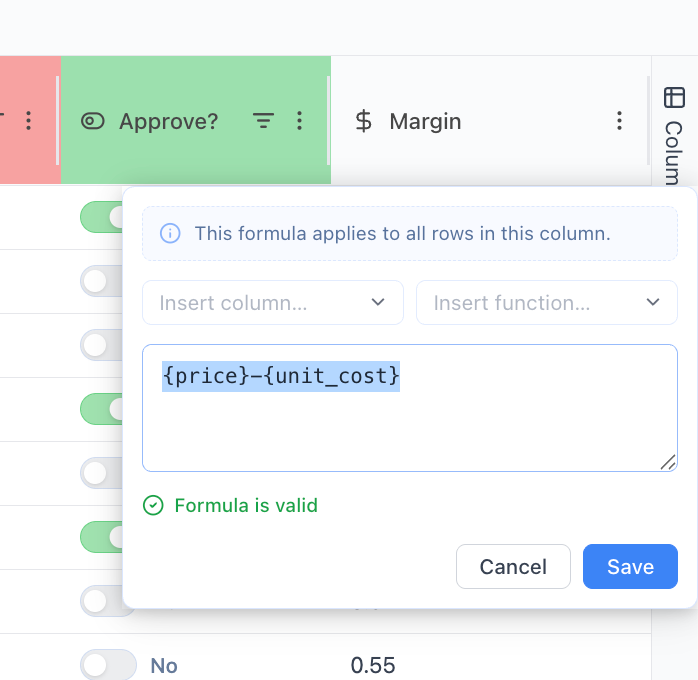
Practical rule for the spreadsheet: keep the shelf price, the member price, and the blended effective price as three separate columns. Do not overwrite the shelf price with a blended number. You need all three to see what the mechanic is doing. Retailgrid users set this up as a grid with the shelf price, a rule-driven member price, and the effective margin computed on the blend. Any tool with a second price list can do the same, and so can a spreadsheet until the assortment passes a few thousand SKUs.
One more input that gets missed: cost. The effective discount comes off the price. The margin impact comes off the price minus cost. A 3% member discount on a private-label item with 40% margin costs you 7.5% of the margin on that unit. On a branded item at 18% margin, the same 3% costs 17% of the margin. The discount is identical. The damage is not.
Step 2: assign the discount by product role, not by category
The most useful change a category manager can make to a loyalty offer is to stop applying it uniformly. Uniform member discounts feel fair and are easy to explain. They are also the most expensive design, because they spend the same money on items that drive perception and on items that drive nothing.
Use the product roles you already have for shelf pricing. If you have not built them yet, the KVI primer covers the basics and the price perception workflow shows how to keep them honest. Three roles matter here.
Known value items. These already carry the lowest margin in the range because their shelf price is set against competitors. Layering a member discount on top is a double cut. The shelf price does the perception work. The member price adds cost without adding perception, because the customer already thinks the item is cheap. Keep member discounts on KVIs at or near zero, or make them conditional on basket size so they only trigger when there is margin elsewhere in the trolley to pay for them.
Private label and margin builders. This is where the member discount earns its keep. Petco's 3x multiplier on own brand is the right instinct: the margin is there to fund it, and shifting a member from a branded item to your own label is a structural gain that outlasts the promotion. The question is whether the switch rate justifies the size of the discount. Model a 2% and a 3% version and find the switch rate needed to break even. With no switch data yet, launch at the lower number. It is much easier to raise a member benefit than to cut one.
Long tail and low-frequency items. Members rarely buy them, so the discount costs little. It also does little. Either exclude the tail to keep the offer simple, or make it the home for personalised offers, where a targeted discount on a rarely-bought item can drive a real incremental purchase.
The output of this step is a member discount rate per role, applied as a rule, not as a manual edit per SKU. When the loyalty team wants to change the mechanic next quarter, you change three rules, not ten thousand cells.
Step 3: set guardrails before launch, not after the quarter
Petco's numbers surfaced in an earnings call, so the programme ran most of a quarter before the overshoot became a board-level fact. That is the normal cadence when loyalty is a budget line. It is far too slow when loyalty is a price. Nobody lets a shelf price run ten weeks below floor without an alert. The member price deserves the same rules. Three of them, set before launch.
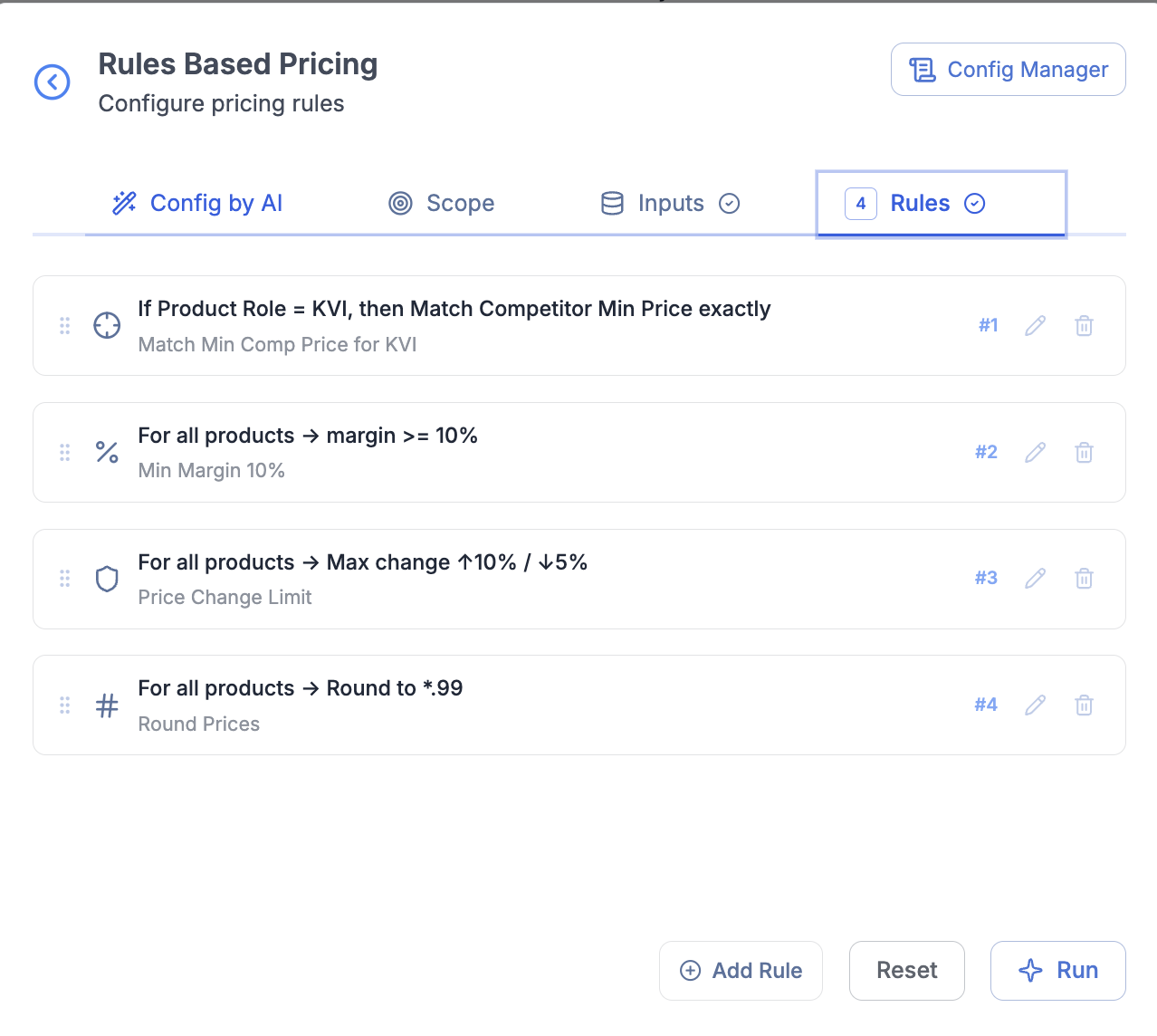
A margin floor on the effective price. Take the floor you already use for shelf prices and apply it to the blended member price, not the shelf price. If the shelf price is at floor, the member discount on that SKU is zero by construction. This one rule catches most of the KVI double cut, and it gives the loyalty team a clean answer on exclusions: not "the category manager said no", but "the margin is not there".
A competitor index on the member price, as well as the shelf price. If your competitor price monitoring tracks a rival's shelf price, but that rival runs its own member scheme, you are comparing your public price to their public price while both sets of customers pay something else. Decide which comparison matters for each role. For KVIs, the shelf-to-shelf index still drives perception, because that is the price on the shelf edge and in the flyer. For private label, the member-to-member index is closer to what a switching customer experiences. Track both. Do not let the member discount push a KVI's effective price so far below the market that you are giving away margin nobody asked for.
A legal check on how the member price is shown. This one is specific to Europe, and it is not optional. The EU Omnibus rules on price reductions require that any announced reduction be shown against the lowest price of the prior 30 days. Whether a member-only price counts as a "price reduction" depends on how it is presented and on the national implementation. Before you put "member price" next to a struck-through shelf price, get a view from whoever owns compliance; our Omnibus compliance page covers the general mechanics. The practical rule: if the member price is a permanent second price rather than a temporary reduction, present it as one, and keep the reference-price history for both.
Set all three as rules in the same system that holds the shelf price, so they run on every reprice. Explainable, auditable, rules-based pricing is the difference between finding the overshoot in week two and finding it on the earnings call.
Step 4: watch redemption weekly, by role, not quarterly, in total
The programme's own dashboard shows enrolment, active members, and points issued and redeemed. Those metrics tell you the scheme is popular. They do not tell you what it is doing to the category P&L, because they are not cut by product.
Build a second, smaller view from the sales data you already have. Four columns per product role, refreshed weekly: member share of units, blended effective discount, gross margin rate versus the pre-launch baseline, and the competitor index on the effective price. Five lines of output, one per role, is enough. The signal you are looking for is divergence between roles. If margin is holding on private label and falling on KVIs, the mechanic is landing in the wrong place and Step 2 needs revisiting. If the effective discount is climbing week on week across every role, redemption is running ahead of the forecast, and you have three or four weeks to adjust the earn rate before it becomes a quarter.
Two things to watch that the programme metrics will hide. First, stockpiling. A rich points multiplier on a storable category pulls forward demand that would have come anyway, at full price. The programme dashboard reads this as a success. The category P&L reads it as a discount on units you were going to sell regardless. Second, promotional stacking. If a member discount can be combined with a shelf promotion, the effective discount on that SKU during the promo week is the sum of both. Your promo calendar and your member rules need to know about each other, or the deepest cut of the year happens by accident.
The redemption forecast should be a range, not a number, with the assumptions recorded next to it. Actuals at the top of the range are information. Actuals above it mean the earn rate is wrong, and the earlier you know, the cheaper the fix.
What good looks like
None of this argues against member pricing. Petco's own reading is that the mechanic is a growth catalyst that needs better targeting, and the JD Sports trials point the same way: relevance moved spend more than discount depth did, especially among high-value customers. Research cited alongside those trials found that 49% of UK consumers say a personalised, product-specific discount makes them more likely to buy, against 26% for a general brand promotion. The direction of travel is toward more member pricing, more personalisation, and more mechanics layered on the shelf price. That is precisely why the shelf price and the member price need to live in the same row.
A category team that has done the four steps can answer the questions a loyalty launch actually raises. What does this cost per SKU? Where does it pay back, and where is it a double cut? What stops it breaching floor? How soon would we know if redemption ran hot? Those answers turn a loyalty launch from something the category team absorbs into something it co-owns.
If you are modelling a member price or a points change and want to see how it looks as a second price list in a rules-based grid, talk to us. Bring the mechanic and a sample of the range. It is a short exercise, and it is a lot cheaper than discovering the effective discount on an earnings call.
Sources: Retail Dive, 4 September 2026 (Petco Q2 2026 results and loyalty programme mechanics); ESM Magazine, 2 September 2026 (Kaufland Card XTRA); InternetRetailing, 3 September 2026 (JD Sports personalised offer trials, Wunderkind consumer research).
Founder and CEO of Retailgrid. 20 years in retail pricing, from Nielsen and IBM DemandTec to founding GoalProfit, a price optimization company he sold in 2023.