Pricing Architecture for a Trade-Down Decade: C-Suite Playbook
Shoppers are trading down retailers, not just brands. Rebuild your pricing architecture for a barbell market and protect mid-market retail margin in 2026.
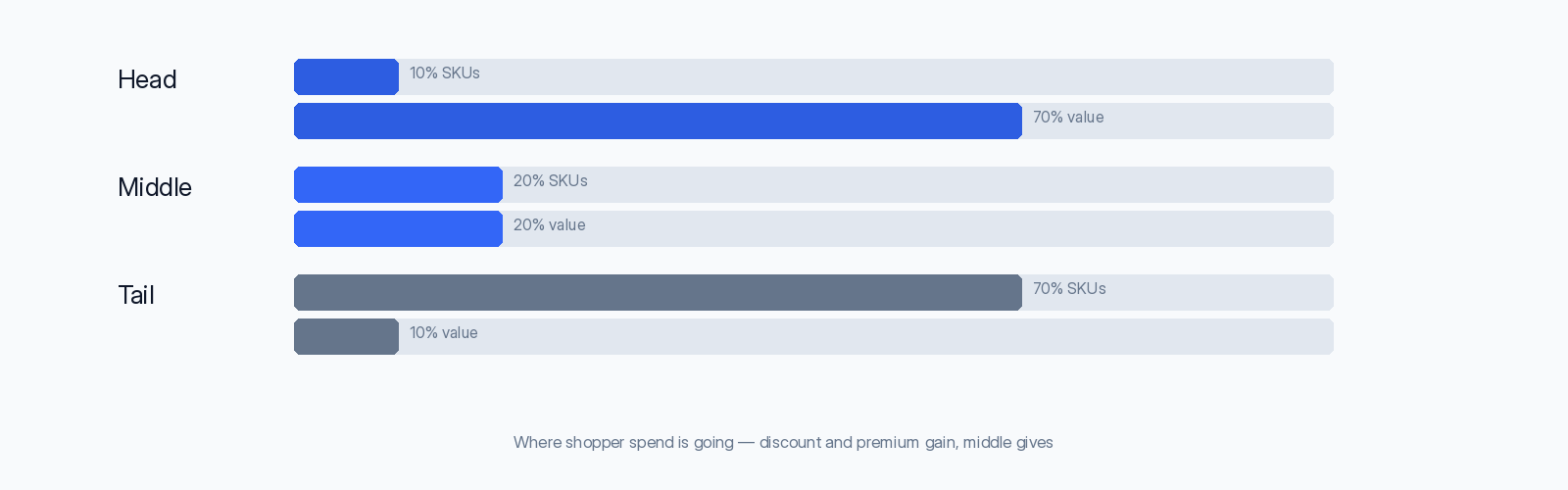
The shopper is no longer just trading down on brands. They are trading down on retailers. Forty-two percent of US grocery shoppers told a recent industry survey they plan to switch to a less expensive store this spring — up from thirty-one percent the previous fall (Retail Dive, May 2026). Private label is no longer the cheap option; it is on track to capture a quarter of grocery unit share, at gross margins north of forty percent (just-food, 2026). The barbell — discount on one side, premium on the other — is widening. The mid-market is being squeezed from both ends.
If you are the CEO, CFO, or chief commercial officer of a mid-market retailer doing €10M–€500M in revenue, your pricing architecture — the standing logic that governs how prices in your assortment relate to each other — was probably built for a different decade. It assumed a stable, mid-priced shopper who would absorb modest cost-pass-through and stay loyal. That shopper has thinned out. The question is no longer "where do we price?" — it is "what does our pricing architecture need to look like so we still have a margin to defend in 2028?"
What's actually happening in the basket
Three structural shifts are colliding inside the same shopping trip.
Shift one: the destination is back in play. For a decade, the dominant retail story was channel migration — physical to digital, supermarket to discounter, supermarket to club. That story continues, but a faster movement is now layered on top of it. Shoppers are not just changing where they shop online; they are changing which physical chain they trust to be cheap. Loblaw, the Canadian grocer, just reported a strong Q1 explicitly led by its discount banners and ecommerce, while traditional banners drifted (Supermarket News, May 2026). When the same parent company sees its discount fascia accelerate and its mainline fascia slow, that is not promotion mix — it is structural reallocation.
Shift two: private label has crossed a threshold. The PLMA 2026 conference, the global private-label trade event, framed this year's theme as "From Price to Relevance" (ESM, May 2026). Shoppers no longer trial private label because they are broke; they buy it because it is good. That changes the gross-margin math. National brand margins in grocery typically sit in the 25–35% range; well-managed private label can deliver 40%+. The retailers winning the trade-down moment are also widening their own-margin advantage as they do.
Shift three: cost pressure is unfinished business. UK retailers including Next, M&S, and the major grocers warned in early May that Middle East shipping disruption will feed back into shelf prices in coming quarters (Internet Retailing, May 2026). US household-goods prices posted their largest monthly jump since September (Supermarket News, May 2026). There is no clean window in which cost-pass-through pressure goes away.
The combination is brutal for the middle. Discounters gain on price perception. Premium gains on value-when-it-matters. The middle gets caught defending its old position with a pricing system that was never designed for what the basket now does.
Why pricing architecture, not pricing tactics
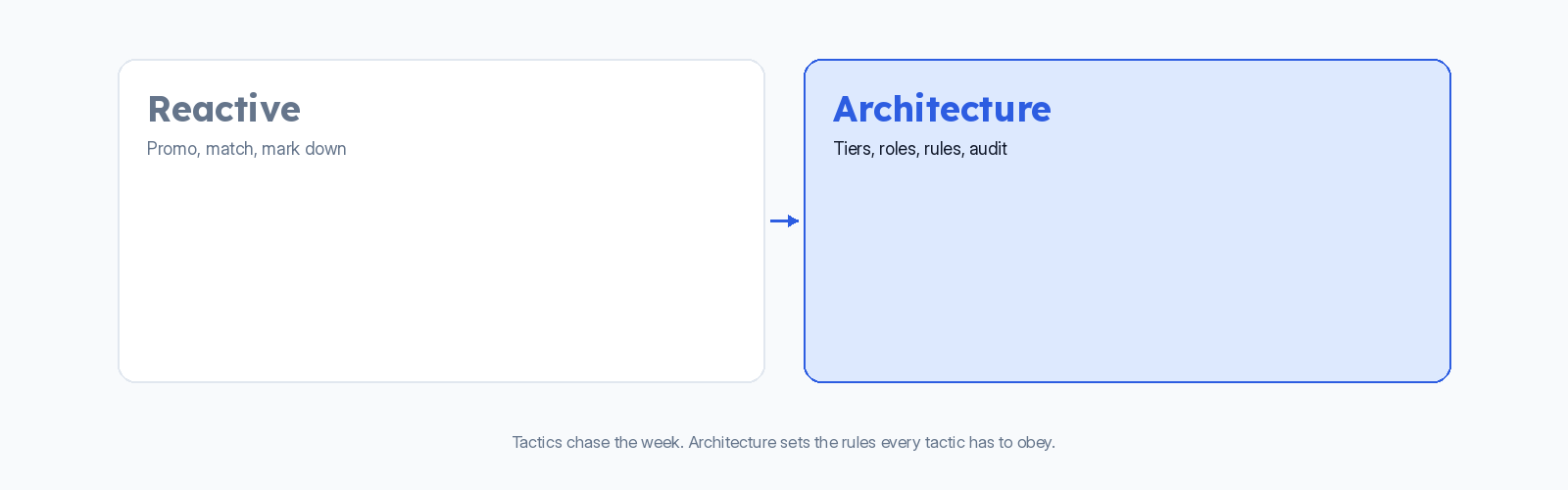
Most mid-market boards still treat pricing as a tactical question — promo calendar density, competitor matching cadence, the markdown rule for end-of-season. Those are real levers, but they are not the lever that breaks when the shopper changes shape.
Pricing architecture is the layer above tactics. It is the set of standing decisions about how prices in your assortment relate to each other, what each price point is supposed to communicate, and where margin is structurally allowed to come from. BCG defines it as "the pricing basis and offer structure that reflects the ways different elements of an offer — and different offers in a portfolio — relate to each other" (BCG, B2C Pricing). In retail terms: it is the price relationships across good-better-best tiers, pack sizes, private label versus national brand, KVI versus background SKU, and category-to-category positioning.
When shopper behavior is stable, architecture is easy to ignore. Tactics fix everything. When shopper behavior shifts — like now — architecture becomes the constraint. A retailer with a clean architecture can re-tier in weeks. A retailer without one will spend two seasons firefighting and still end up with eroded gross margin.
The four architectural decisions you cannot defer
For a CEO/CFO running a mid-market retail business with 10,000–200,000 SKUs across one to five banners, four decisions sit on the table this year. None of them are tools questions. All of them are policy questions that determine which tools are useful at all.
1. Where does private label sit, and what is its job?
Private label is now strategy, not procurement. Decide whether your own brands exist to (a) anchor a value tier below the national brand, (b) parallel the national brand at near-parity quality and a clear price gap, or (c) lead the category as a destination-quality offer the way the big European discounters now do. The answer determines your sourcing model, your promo policy on own brand, your KVI list, and the gross margin you should reasonably expect at the category level. Mid-market retailers that try to do all three at once typically end up with a private label range that is neither cheap enough to defend against discounters nor distinctive enough to defend against premium. Pick one job per category. Make it explicit. Publish it inside the company.
2. What is your good-better-best ladder, and is it visible to the shopper?
The principle goes back at least as far as BCG's pricing architecture work in the 2000s, and it has gotten more important, not less, in a trade-down decade. A shopper trading down inside your store is more valuable than a shopper trading down to someone else's store. That only happens if there is somewhere obvious to trade down to — a cheaper-but-acceptable option, on the same shelf, in the same trip. Good-better-best pricing makes that visible. It also gives the analyst team a defensible structure when costs move: which tier absorbs, which tier passes through, which tier widens its gap.
3. What is the role of each SKU, and how does that change the rule?
Not every SKU does the same job. KVIs (known-value items) build price perception and should be priced against the cheapest credible competitor. Traffic builders should support promotion mechanics. Background SKUs — the long tail that drives a quiet majority of margin — should be priced for margin, not perception, because the shopper does not check them. Most mid-market retailers know this in principle and ignore it in practice, repricing 80% of SKUs on the same rules as the 20% the shopper actually compares. Trade-down behaviour amplifies the cost of that mistake; the 80% is where the structural margin lives.
4. How fast can the architecture change?
Architecture is not a one-time document; it is a living set of policies. The retailers that handled 2022–2024 well rewired their architecture more than once. The ones that handled it badly relied on weekly promo to substitute for a structural answer. Ask your team how long it would take to re-tier a category — change the price ladder, redefine the KVI list, reset the private-label gap. If the honest answer is "two quarters", the architecture is locked. Unlocking it is the highest-ROI pricing project you can run this year.
What the trade-down decade actually requires from the tooling
This is the part where most consulting pieces stop. We will not. If the board takes the four decisions above seriously, the operational requirements fall out naturally — and they are deeply unromantic.
You need one structured view of price, not seven spreadsheets. Architecture decisions are useless if no one can see them. Every analyst should be able to look at any SKU and read its tier, its role, its KVI status, its private-label relationship, and its rule. Today, in the typical mid-market retailer, that information is fragmented across the merchandising system, three pricing spreadsheets, a Google Doc of policy notes, and the head of category's memory.
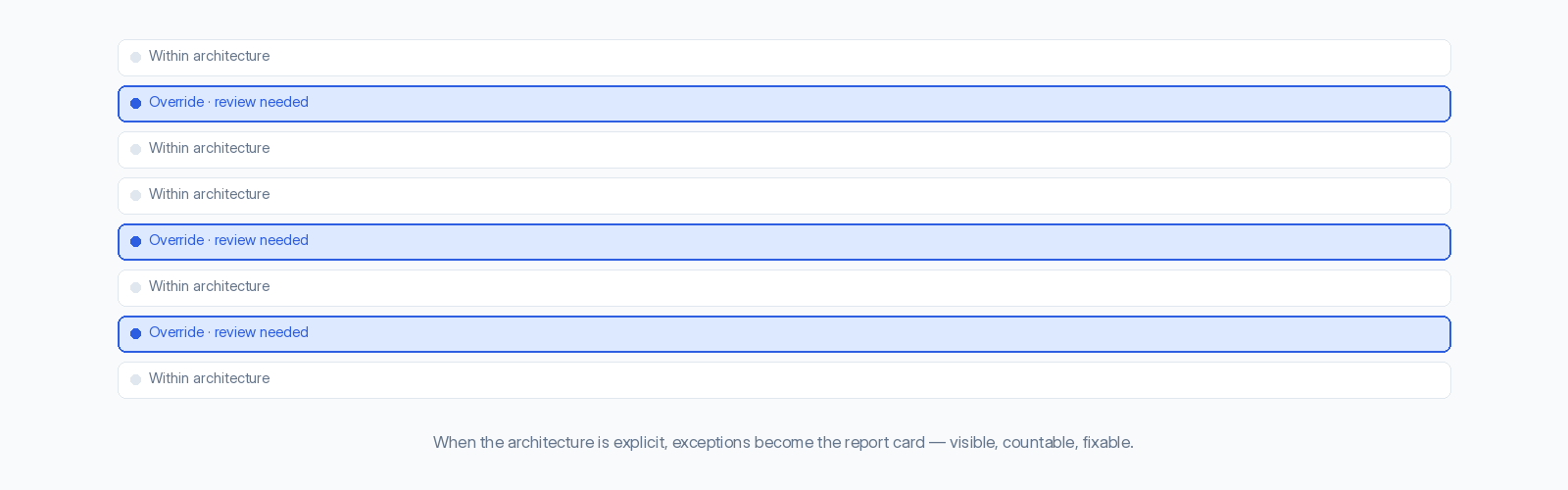
You need explainable rules, not black-box recommendations. "The AI said so" does not survive a CFO conversation about a 60-basis-point margin variance. Every price the system proposes should be traceable to the architectural rule that produced it: this is a KVI matched to competitor X; this is a tier-2 SKU held at +12% to tier-1; this is a private-label gap protected at 25%. When the rule and the price are both visible, exceptions are obvious and fixable. When neither is visible, you are running on faith.
You need a weekly cadence, not a quarterly one. The cost news in May 2026 will not be the cost news in August. Cycle time on architectural review needs to compress from "annual reset, quarterly tune" to "monthly review, weekly exceptions". That does not mean repricing everything every week. It means the architecture is alive enough that the team notices, in week one, when category X breaks the rules, instead of finding out at the quarterly review.
You need decision-grade audit, not after-the-fact reporting. When the CFO asks why gross margin in personal care fell 40 basis points, the answer needs to come back in hours, not days, with the line of price changes and rule overrides that caused it. Otherwise the architecture quietly drifts; the price ladder you signed off on in Q1 is not the price ladder running in Q3, and no one can quite say when it changed.
What this doesn't change
A few things to take off the table, because they show up in every C-suite pricing conversation and they distract from the real work.
This is not a call to drop prices across the board. Trade-down behaviour does not mean shoppers want a 5% cut everywhere. It means they want the right prices to be cheap — KVIs, value tiers, frequent-basket items — and they are happy to pay more elsewhere when the proposition is right. A blanket cut destroys margin without changing shopper behaviour.
This is also not a private-label-versus-brand fight. Most mid-market retailers will continue to need both. The architectural question is how the two relate, not which one wins.
And this is not a tooling-first project. New pricing software, no matter how capable, will not save a retailer who has not decided what their pricing architecture is supposed to do. The order is: policy first, then the system to operate the policy. Reversing that order is how mid-market retailers end up with €200k of pricing software running last decade's strategy.
A 90-day path that actually works
For boards looking for a concrete first move, the following sequence has worked for the mid-market retailers we talk to most often.
Days 1–30: name the architecture you already have. Have the commercial team document the implicit policies in plain language. Where does private label sit? What does the good-better-best ladder look like in your top five categories? Which SKUs are KVIs and who decides? You will discover, as most teams do, that there is no single document — and that key people disagree on the basics. That alone is the finding.
Days 31–60: pick one category to rebuild. Pick a category that is large enough to matter and bounded enough to finish. Rebuild its architecture from scratch on paper — tier definitions, KVI list, private-label role, rule per SKU role. Resist the temptation to do this in the existing system; the goal is the policy, not the tool.
Days 61–90: instrument it. Put the rebuilt category into a system that can hold the architecture explicitly — rules, tiers, roles, exceptions. Run it for thirty days. Measure realised gross margin against the same period in the prior year, controlled for cost. Look at exceptions: how many price changes the team had to override the rule for, and why. The exception count is the architecture's report card.
This is the project Retailgrid was built to support — structured pricing with the spreadsheet feel commercial teams already trust, and the audit trail a board actually wants. If that sounds useful, we put together a short overview of how it works and a demo you can scope to your own categories.
The board takeaway
The next two years will not be kind to retailers who run last decade's pricing on this decade's basket. The barbell is widening; the mid-market position is not stable; private label has matured into a strategic margin tool, not a defensive one. The retailers who come out of this with their gross margin intact will be the ones who treated pricing as architecture — explicit, auditable, fast to change — rather than as a tactical reflex.
The good news, for once, is that the work is internal. No one needs to wait for cost pressure to ease or for the consumer to come back. The architecture decisions sit entirely inside the company, the data needed to make them is data the retailer already has, and the operational cadence required to run them is a quarter, not a year. The retailers that start the conversation in Q2 will be operating differently by Q4. The ones that wait will spend Q4 explaining margin to the board.
Founder and CEO of Retailgrid. 20 years in retail pricing, from Nielsen and IBM DemandTec to founding GoalProfit, a price optimization company he sold in 2023.